
Central London

Air Conditioning in Fitzrovia

Fitzrovia packs agencies, edit suites, restaurants and flats into the same narrow buildings north of Oxford Street. We install, service and repair air conditioning here with heat-heavy workspaces, close neighbours and a borough boundary running through the middle all taken into account.

  • W1T
  • W1W

Free quote in Fitzrovia

Homes and businesses: tell us what you need and we’ll be in touch.

Agencies, Studios, Restaurants and Upper-Floor Flats in Fitzrovia

Fitzrovia occupies the compact block of streets between Oxford Street, Euston Road, Great Portland Street and Tottenham Court Road, with the BT Tower rising over its middle. Its building stock is mostly narrow Georgian and Victorian houses and workshops, now with shops or restaurants at street level and offices, studios or flats above, punctuated by larger modern schemes such as Fitzroy Place on the former Middlesex Hospital site. Fitzroy Square, with its stone-faced Robert Adam elevations, is the most formal corner.

The area's working population is dominated by advertising and media agencies, architects, design studios, production companies and technology firms. Their floors are full of high-specification workstations, large monitors, render machines and meeting rooms booked back to back, so the cooling load per square metre is often far higher than the building was ever designed for. Many of these businesses lease one or two floors of an old house with no central plant, which means cooling has to be added tenancy by tenancy.

Charlotte Street, Goodge Street and Rathbone Place are lined with restaurants, while residents live in mansion blocks, flats over shops and housing association buildings tucked behind the main roads. That mix puts commercial plant within a few metres of bedroom windows on almost every project. Good air conditioning design in Fitzrovia is as much about acoustic and neighbourly placement as it is about capacity.

Our services

Cooling for Fitzrovia Homes, Workspaces and Kitchens

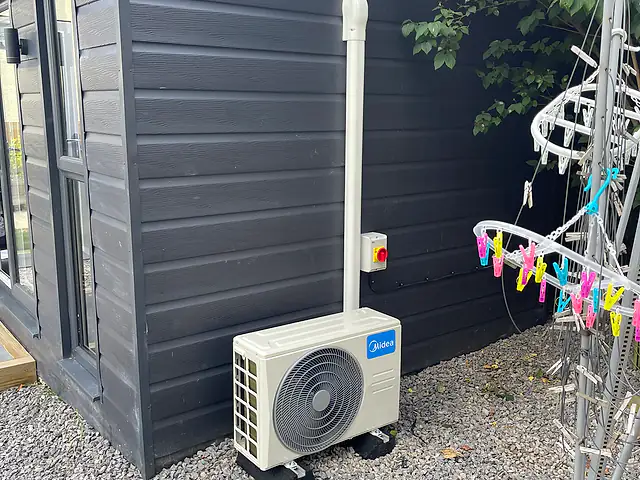
An outdoor air conditioning unit beside a garden room, the kind of air conditioning we fit for homes in Fitzrovia
An outdoor air conditioning unit beside a garden room. An example of the air conditioning we install for homes in Fitzrovia.

For homes

Fitzrovia flats tend to be on upper floors where summer heat builds up under the roof and warm air rises from shops and kitchens below, and opening sash windows onto Charlotte Street or Cleveland Street means late-night noise. We install quiet split and multi-split heat pumps for bedrooms, living rooms and home offices, with indoor units chosen for low sound levels on night mode. We also help assemble the equipment details your freeholder or managing agent will want to see, and the same system can provide efficient heating in winter.

Domestic air conditioning
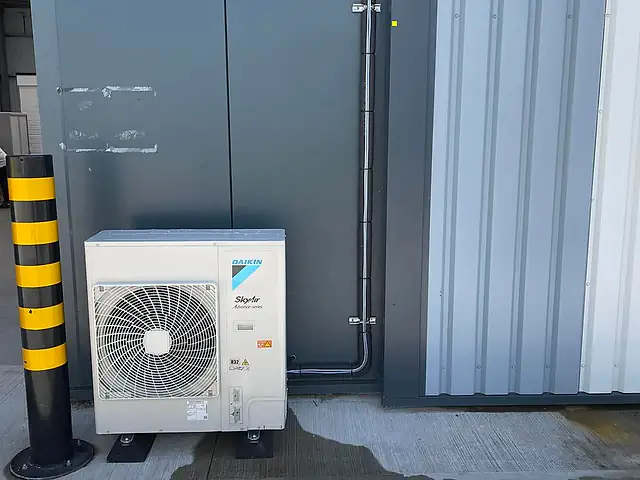

A commercial outdoor air conditioning unit on anti-vibration feet, the kind of commercial air conditioning we fit for businesses in Fitzrovia
A commercial outdoor air conditioning unit on anti-vibration feet. An example of the commercial air conditioning we install for businesses in Fitzrovia.

For businesses

Commercial work in Fitzrovia centres on agencies, production companies, architects, tech businesses, restaurants and healthcare practices. We install, service and repair split, cassette, ducted and VRF systems, and we separate comfort cooling for people from continuous cooling for equipment so that server rooms and machine rooms are protected when office systems are turned off. In buildings shared with residents, noisy tasks are scheduled sensibly and condensers are selected with sound data in hand rather than chosen after the event.

Commercial air conditioning

Keeping Edit Suites, Agency Floors and Comms Rooms Cool

Fitzrovia's working buildings carry heat loads that domestic-style sizing rules badly underestimate. The answer is to calculate cooling from what is actually in each room and to split the systems that keep people comfortable from those that protect equipment, because they run on different schedules.

Sizing from screens, workstations and people

A meeting room for ten people with a large display can need several times the cooling of a similar-sized bedroom, and a row of render workstations adds heat continuously. We assess occupancy, equipment wattage, lighting and solar gain through south or west-facing windows room by room, then select indoor units in kilowatts that match the real load. Oversized units short-cycle and dehumidify poorly, while undersized ones run flat out and still fail on hot afternoons.

Why studios need cooling at weekends

Renders, backups and remote sessions often run overnight and at weekends when the office is empty. If comfort cooling is time-scheduled off, equipment rooms need a separate system or at least an independently controlled indoor unit that keeps running.

Quiet cooling for edit and audio rooms

Sound-sensitive rooms need indoor units whose published sound pressure level on low fan speed is genuinely low, and air delivered slowly across the room rather than blasted at the mix position. Ducted units hidden in a ceiling void, with oversized grilles and acoustically lined plenums, usually beat wall-mounted units in these spaces. Condensate pumps should be placed outside the room, because their intermittent hum is noticeable in a quiet suite.

Grille selection and air velocity

Air noise rises sharply with velocity, so a larger grille passing the same airflow more slowly is quieter. Positioning supply grilles away from microphones and listening positions reduces both noise and draughts that engineers notice during long sessions.

Dedicated cooling for comms and server rooms

Agency comms rooms are frequently converted cupboards with no ventilation. A dedicated split unit rated for year-round operation, with low-ambient capability so it keeps working in winter, and a temperature alarm, protects the network independently of the office system.

  • Size from the actual equipment load in kilowatts
  • Consider a second unit for resilience if downtime is costly
  • Fit a high-temperature alert to email or phone
  • Service at least as often as the office systems

Which Council Handles Air Conditioning Plant in Fitzrovia?

It depends on which side of the Westminster and Camden boundary your building sits. Both councils treat external plant in conservation areas seriously, and both will be interested in noise where commercial equipment is near homes, but their forms, guidance and conservation area appraisals differ.

Camden side, east of Cleveland Street

Most of the area around Charlotte Street, Fitzroy Square and Goodge Street falls within Camden, and much of it lies in conservation areas. Fitzroy Square itself has listed terraces where both external units and internal pipe routes are likely to require listed building consent. A rooftop position behind a parapet, invisible from the square, is usually the starting point for any proposal.

Westminster side, towards Great Portland Street

The western part of Fitzrovia is in the City of Westminster, which also has conservation areas covering many streets here. Westminster is likely to expect an acoustic report with applications for commercial plant near residential windows. If your business rates bill is issued by Westminster, that is the authority to approach for any planning advice about external equipment.

Restaurant Plant Below Bedroom Windows on Charlotte Street

Restaurants here usually share their building with flats, and their rear yards and roofs face other people's bedrooms. Cooling plant has to be sized for full evening service while staying quiet late into the night.

Coordinating cooling with kitchen extract

Kitchen extract fans and ducts often already occupy the best rear positions. Placing a condenser where it draws in hot extract air reduces its capacity and efficiency, so we map existing plant first and keep cooling equipment upwind and clear of exhaust discharges. Where space is tight, a single larger outdoor unit serving several cassettes can replace multiple small condensers and free up room.

Acoustic enclosures and night-time operation

Restaurants trade late, which is exactly when background noise drops and condensers become most noticeable to residents. Units with a low-noise night setting, anti-vibration mounts, flexible pipe connections and acoustic louvres or enclosures help keep the sound level at neighbouring windows down. Timers can stop non-essential cooling after closing so the plant only runs when it is needed.

Local properties

Buildings Between Tottenham Court Road and Great Portland Street

Agency floors and design studios

Open-plan floors with dense desking and powerful computers suit slim ducted units or cassettes on a multi-split or small VRF system, giving each meeting room its own control. Condensers normally go on the main roof, reached through the stair core or a hatch.

Edit suites and sound-sensitive rooms

Rooms used for editing, grading or audio work need cooling that runs whenever the equipment does while staying close to inaudible. Low-velocity ducted grilles or carefully positioned wall units on their lowest fan speeds are preferred over cassettes blowing directly across the room.

Restaurants on Charlotte Street and Goodge Street

Dining rooms that fill to capacity, with heat spilling from open kitchens, need commercial cassettes or ducted units sized for the evening peak. Outdoor units have to be positioned away from the windows of flats above and coordinated with existing kitchen extract ducts.

Mansion flats and flats above shops

Residential blocks often restrict external equipment, and flats over restaurants gain heat from below as well as through the roof. A multi-split with one roof-mounted condenser can cool bedrooms and a living room while keeping alterations to the building to a minimum.

Before you install

Boundary, Noise and Access Issues North of Oxford Street

This is general guidance only. Every building, lease and planning situation is different, so we’ll talk through yours at survey stage.

  1. 01Fitzrovia is split between Westminster and Camden, and the boundary runs roughly along Cleveland Street. Each council has its own conservation areas and planning process, so confirming which authority covers your address is the first step for any external plant.
  2. 02Commercial condensers frequently sit on the same rear roofs that flats look out over. Expect the council to take a close interest in plant noise, and budget for acoustic screening or anti-vibration mounts where a unit will be close to a habitable window.
  3. 03Streets are narrow, parking is controlled and loading is restricted at busy times. Deliveries of larger outdoor units are best planned for permitted loading windows, and the Congestion Charge applies.
  4. 04Many older buildings have roof access only through a hatch or a steep final flight of stairs, which limits the size of condenser that can be carried up and may favour two smaller units over one large one.
  5. 05Tenants on a single floor of a multi-let house will normally need the landlord's written consent, and the landlord may want to agree where future tenants' plant will go on the roof as well.
Pricing explained

Cost Drivers for Fitzrovia Offices, Studios and Flats

Every Fitzrovia quote is built after a survey and broken into equipment, installation labour, access, electrical work and any acoustic or consent support. The figures move most with heat load, the number of rooms needing independent control and how difficult it is to get equipment onto the roof of an old, narrow building.

Equipment loads in studios and agencies

Rooms full of workstations and displays need more cooling capacity than floor area alone suggests. Higher capacity means larger or more indoor units, bigger pipe sizes and potentially a larger electrical supply, all of which affect the cost of the project.

Acoustic measures near neighbouring flats

Where condensers are close to residential windows, acoustic enclosures, louvres, anti-vibration frames or a noise assessment for a planning application may be needed. These are often the difference between a scheme the council accepts and one it does not.

Roof access through hatches and narrow stairs

If a condenser cannot be carried through the building, lifting equipment or a crane with a road licence may be needed, and that brings its own permits and scheduling. Choosing smaller, modular outdoor units can sometimes avoid that cost altogether.

Working outside office or service hours

Agencies and restaurants often want installation in evenings or at weekends so the working day is unaffected. Out-of-hours programmes are priced to reflect that, and agreeing them at quotation stage keeps the cost transparent.

Step by step

Our Four Stages for a Fitzrovia Project

  1. Load survey of your floor or flat

    We measure each room, record equipment, occupancy and glazing, and check roof access, riser routes and existing kitchen extract or plant. We also confirm whether your building falls under Westminster or Camden.

  2. Design and landlord consent

    You receive a layout showing indoor units, pipe routes and the outdoor unit position, with sound data for the condenser. We provide what your landlord, managing agent or the council may ask to review.

  3. Installation timed around your business

    Core drilling and other noisy tasks are scheduled before or after working hours where needed, equipment is carried in to suit the stairs and hatch, and work areas are cleaned down each day so studios can keep running.

  4. Commissioning, controls and aftercare

    We test and commission the system, set schedules so equipment rooms keep running out of hours, and explain the controls. Servicing intervals are recommended according to how hard the system works through the year.

FAQs

Fitzrovia Air Conditioning Questions, Answered Plainly

How should I cool an edit suite or studio in Fitzrovia?

Studios need cooling that runs whenever the equipment is on while adding as little noise as possible. A ducted unit in the ceiling void with large, low-velocity grilles is often the best solution, or a wall unit selected for a very low sound level on its quietest fan speed. The capacity should be calculated from the actual equipment and occupancy, not just the room size, and condensate pumps are best located outside the room.

Is my Fitzrovia building in Westminster or Camden?

As a rough guide, streets east of Cleveland Street fall in Camden and those to the west fall in Westminster, but the line is not perfectly straight. Your business rates or council tax bill shows which council covers your address. That matters because the planning authority, conservation area guidance and noise expectations for external plant differ between the two councils.

Can a restaurant condenser be fitted below residential flats?

It is common, but placement and noise control are critical. A position away from bedroom windows and clear of kitchen extract discharge is preferable, and acoustic enclosures, anti-vibration mounts and night-time fan limits can all help. The council is likely to ask for a noise assessment if a planning application is required for commercial plant close to homes.

We rent one floor of a Fitzrovia townhouse. Can we install our own system?

Usually, with the landlord's written consent. Your lease will set out what alterations are allowed and where plant can go. We prepare a proposal showing the indoor units, pipe route and outdoor unit position, with equipment data, so the landlord can approve it. Planning permission may also be needed for the condenser depending on its location and the building's status.

Do agency meeting rooms need separate controls?

It is strongly advisable. Meeting rooms swing from empty to full in minutes, and a room with ten people and a large screen needs much more cooling than the open office next to it. Giving each meeting room its own indoor unit and controller, on a multi-split or VRF system, avoids the common problem of rooms becoming stuffy halfway through a session.

How often should a Fitzrovia office system be serviced?

Most office systems benefit from servicing at least once a year, and busy floors with dense desking or dusty environments often need filters cleaned more frequently. Systems that cool comms rooms or edit suites all year deserve closer attention because a failure affects work immediately. Regular servicing keeps coils clean, checks refrigerant performance and keeps indoor units quiet.

Close to Fitzrovia: Other W1 and WC1 Neighbourhoods

Free quote

Request a Survey for Your Fitzrovia Office, Studio or Flat

Tell us about your home or business in Fitzrovia and what you’d like to achieve, whether that’s cooling, heating or both. We’ll come back with advice and next steps.

  • Survey-led advice: recommendations based on your rooms, layout and how you use the space.
  • Clear written quotation: what’s included, the equipment proposed and the next steps.
  • No obligation: ask questions and take your time to decide.
  • CoverageHomes & businesses across Greater London

Request your free quote

A few details help us understand your property and come back with useful advice.

Fields marked * are required. We only use your details to respond to this enquiry.
Get a Free Quote

