
Areas we cover

Air Conditioning Across North London

North London asks a lot of a cooling system: hilltop Victorian houses near the Heath, conversion flats in Haringey, interwar semis in Barnet and Enfield, and Lea Valley workplaces. We design, fit, service and repair air conditioning to suit each of them.

Free quote in North London

Homes and businesses: tell us what you need and we’ll be in touch.

Hills, Heathland and Suburbs: Why North London Homes Overheat

The short answer is that most North London overheating problems come from three places: the top floor, the glazed rear extension and the room that faces west. The region’s high ground around Hampstead, Highgate, Muswell Hill and Alexandra Palace puts many upper rooms in full afternoon sun with no shade from neighbouring buildings, and the loft conversions that are now standard on Victorian and interwar streets trap heat under slate and tile for days at a time during a hot spell.

The building stock changes as you head out from the centre. Closer in, around Kentish Town, Highgate, Crouch End and Stroud Green, Victorian terraces and villas dominate, many divided into two or three flats with shared freeholds. Beyond the North Circular, the avenues of Southgate, Whetstone, Mill Hill and Enfield are lined with semis and detached houses from the 1920s and 1930s, built as the Underground and suburban railways pushed north. Along the Lea Valley and at Colindale, Brent Cross, Wood Green and Tottenham Hale, new apartment blocks bring sealed façades, big windows and management companies with firm rules about external equipment.

That variety is why we survey before we recommend anything. A wall-mounted split that is ideal for a Finchley bedroom may be the wrong answer in a Highgate conversion where the only outdoor space belongs to the flat downstairs, or in a Colindale apartment where the lease forbids fixings to the balcony. We cover the boroughs of Barnet, Enfield and Haringey and the northern parts of Camden and Islington, providing installation, servicing, repairs and replacement for homes and commercial premises.

Our services

Cooling and Heat Pump Work for Northern Households and Firms

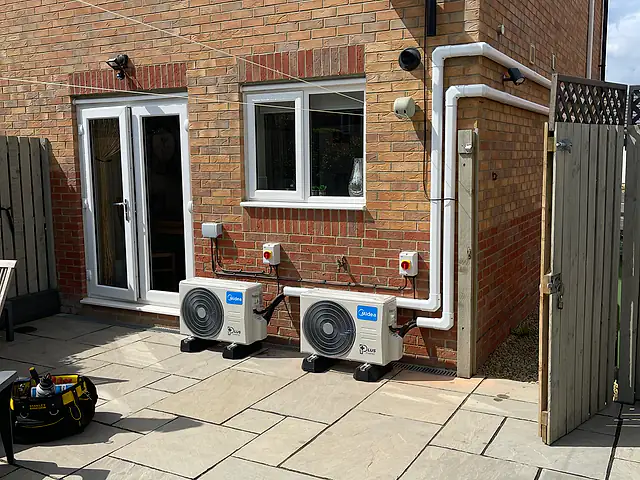
Two outdoor air conditioning units on a patio with neat trunking, the kind of air conditioning we fit for homes in North London
Two outdoor air conditioning units on a patio with neat trunking. An example of the air conditioning we install for homes in North London.

For homes

At home, the requests we get most across North London are for loft bedrooms, children’s rooms facing west and home offices where a computer and monitors add their own heat. We start by finding out which rooms actually overheat and when, then recommend single splits, a multi-split or a concealed ducted unit to match. Every modern split is a reverse-cycle heat pump, so the same indoor unit gives efficient heating in spring and autumn, which is useful in draughty period rooms and in extensions the radiators do not quite reach. After installation we commission the system, show you the controls and app, and offer annual servicing to keep filters, coils and drains clean.

Domestic air conditioning
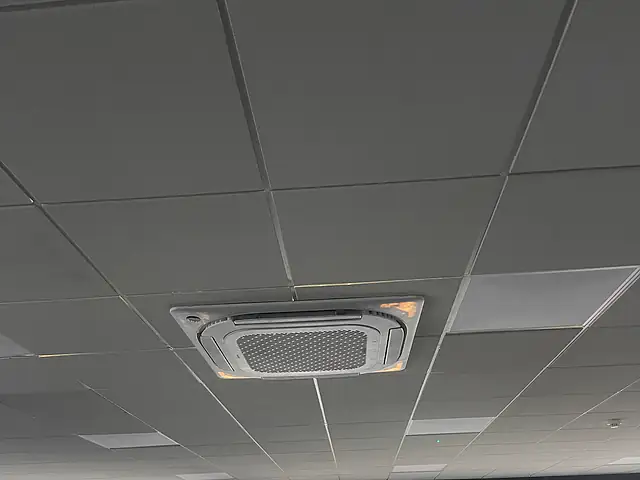

A four-way ceiling cassette in a suspended office ceiling, the kind of commercial air conditioning we fit for businesses in North London
A four-way ceiling cassette in a suspended office ceiling. An example of the commercial air conditioning we install for businesses in North London.

For businesses

North London’s commercial property ranges from independent shops and restaurants on village high streets to clinics, schools, places of worship, offices on the A1 and A41 corridors and warehouses in the Lea Valley. We plan climate control around occupancy, opening hours and equipment heat, whether that is a busy café kitchen in Crouch End, consulting rooms in Finchley or a mezzanine office in Brimsdown. Server and comms cupboards get dedicated cooling designed to run continuously. Alongside new installations we provide planned maintenance, fault finding and repairs, and can help you keep the records needed for regular refrigerant leak checks on larger systems.

Commercial air conditioning

Which System Suits Which Corner of North London?

There is no single right answer for the region, but the equipment choice follows the building type quite closely. The questions that decide it are where an outdoor unit can legally and practically sit, how far the pipework has to travel, and how many rooms need cooling at once. Here is how that tends to play out in the main property types we survey north of the centre.

Single splits for period houses on the hills

In a Highgate or Muswell Hill house where only the loft bedroom and a top-floor study overheat, two single split systems are often better than one multi-split. Each has its own short pipe run to a compact outdoor unit, so a fault in one does not leave you with no cooling at all, and the condensers can be smaller and quieter. This also keeps the routing simple in houses where floors and joists are original and you want to lift as few boards as possible.

  • Indoor units on internal walls avoid cold-bridging on solid external brick
  • Rear closet wing roofs often make the best condenser position
  • Pipe covers painted to match render or brickwork reduce visual impact

Multi-splits for suburban family houses

In the interwar semis of Barnet and Enfield, three bedrooms on the first floor plus a converted loft is a common brief. A multi-split with one outdoor unit and three or four indoor heads keeps the side passage or rear garden tidy. The pipework usually runs up through the loft and drops into each bedroom from above, which means very little visible trunking inside the house.

When a multi-split stops making sense

If rooms are at opposite ends of a long house, or one room needs cooling all day while the others are only used at night, separate systems can be more efficient. A multi-split condenser sized for four rooms runs less efficiently when only one small indoor unit is calling for cooling.

Matching indoor units to bedrooms

Bedroom units should be chosen for low night-time sound levels and quiet fan modes. A unit sized correctly for the room runs gently through the night instead of cycling on and off, which is far less noticeable when you are trying to sleep.

Ceiling cassettes and ducted systems for offices and clinics

High-street offices, dental surgeries and clinics in places like Finchley, Crouch End and Enfield Town often have suspended ceilings or enough void for a concealed unit. Four-way cassettes spread air evenly across open-plan rooms, while slim ducted units hide everything except grilles. For larger floor plates with many zones, a VRF or VRV system can heat some rooms while cooling others from shared outdoor plant.

Sizing Cooling for Lofts, Glazed Extensions and Hilltop Rooms

Undersized units struggle in a heatwave and oversized ones short-cycle, wasting energy and leaving rooms clammy. In North London the two rooms most often mis-sized are dormer loft bedrooms and glazed kitchen extensions, because both gain heat far faster than their floor area suggests. We calculate heat gains room by room rather than relying on a rule of thumb.

Dormer lofts under slate and tile

A loft room loses the protection of a room above it and takes heat directly through the roof slope, the dormer cheeks and any rooflights. Older conversions with thin insulation are worse. On hillside streets with long south or west views, the afternoon sun hits these rooms with nothing in the way. We account for roof construction, window area and orientation, and usually specify a slightly larger indoor unit than the same floor area would need downstairs.

Rooflights and solar gain

Fixed or opening rooflights let in a great deal of direct sun. Blinds with reflective backing reduce the load noticeably, and we factor whether they are fitted into the kW figure we recommend.

Glazed rear extensions and kitchen-diners

Bi-fold doors and roof lanterns have become a feature of North London kitchens, from Haringey terraces to Barnet semis. Those glass areas, combined with cooking heat, make the kitchen-diner the hardest space to keep comfortable on a summer evening. A wall-mounted unit placed high on the party wall, or a ceiling cassette if the extension roof has a void, normally performs better than a floor console competing with kitchen units for space.

Local properties

From Mansion Flats to Metroland Semis Across the Northern Boroughs

Victorian villas and terraces on the northern heights

Tall houses in Highgate, Crouch End and the streets around the Heath often have four storeys, solid brick walls and original cornicing worth protecting. Pipe runs are usually routed through cupboards, chimney breast recesses or the rear closet wing so that indoor units can sit on internal walls, while the condenser goes on a rear flat roof or a ground-level plinth well back from the street.

Interwar semis in the outer northern suburbs

The 1930s houses of Southgate, Edgware, Mill Hill and Enfield typically have a hipped roof, a side passage and a deep rear garden. That combination suits a multi-split: one condenser in the passage or by the back wall, with indoor units in two or three bedrooms connected through the loft void. Lofts here are often converted, so the hottest room is usually right at the top.

Conversion flats in Haringey and Islington borders

Upper flats in converted houses rarely own the garden, may share the roof and almost always need written consent from the freeholder. Short pipe runs to a rear wall bracket, condensers chosen for low sound levels at night and pumped condensate drainage are the details that make these installations work without disputes.

Regeneration apartments and Lea Valley workplaces

New blocks at Colindale, Brent Cross, Wood Green, Tottenham Hale and Meridian Water often have designated plant zones or prohibit visible units altogether. Warehouses and trade units in Brimsdown, Edmonton and along the A406 usually need cooling only in offices, canteens and showrooms rather than across the whole floor area.

Before you install

Consents, Parking Zones and Neighbours North of the Centre

This is general guidance only. Every building, lease and planning situation is different, so we’ll talk through yours at survey stage.

  1. 01Large parts of Highgate, Hampstead, Muswell Hill, Crouch End and Hampstead Garden Suburb are conservation areas, and some houses are listed. A condenser visible from the street may need consent, so it makes sense to check with your local planning authority before you commit to a position.
  2. 02Most flats in converted houses and mansion blocks are leasehold. Leases commonly require written permission from the freeholder or managing agent before anything is fixed to external walls or roofs, and getting that agreed first avoids a stalled installation.
  3. 03Close-packed terraces such as the Harringay Ladder put bedroom windows only a few metres apart. Choosing a condenser with a low sound power rating and siting it away from neighbours’ windows matters more here than on wide suburban plots.
  4. 04Controlled parking zones cover much of the inner north, especially near Underground stations. Booking visitor permits or a bay suspension in advance keeps the installation day running on time.
  5. 05Homes close to the North Circular, the A1 and the A10 often keep windows shut because of traffic noise and fumes, so the system needs enough capacity to cool without any help from natural ventilation.
Pricing explained

What Shapes a Quote for Air Conditioning Across North London

Every quote we prepare is built from the equipment, the installation labour and the access arrangements for that specific building, so two jobs with the same number of rooms can be priced quite differently. These are the factors that make the biggest difference in the northern boroughs, and we explain each line on the quote so you can see where the money goes.

Number of rooms and type of system

A single wall-mounted split for one bedroom is the simplest job. Multi-splits, ducted systems and cassettes add equipment and more labour, while VRF systems for offices involve design work, controls and commissioning across several zones. The more indoor units, the larger and more capable the outdoor unit needs to be.

Pipe run length and route through the house

Tall period houses can mean long refrigerant runs from a basement or garden condenser up to a top-floor room. Longer runs need more copper, insulation and trunking, and routes that pass through finished rooms take more care. Suburban houses with an accessible loft void are usually quicker to pipe.

Access, scaffolding and parking

Condensers on high flat roofs or brackets above the first floor may need a tower or scaffold. Inner areas with controlled parking zones need permits or suspensions arranged in advance, while outer suburbs with driveways are more straightforward.

Electrical work and condensate drainage

Each system needs a dedicated supply and isolator, and an older consumer unit may need attention first. Where a gravity drain to a gully or downpipe is not possible, a condensate pump adds a small amount of equipment and future maintenance.

Step by step

How a Job Runs From First Call to Commissioning North of Camden

  1. Talk through the rooms and the building

    We start with a call about which rooms overheat, the type of property and whether it is leasehold or in a conservation area. That tells us early whether consent from a freeholder, managing agent or planning authority is likely to be part of the job.

  2. Survey the property in person

    At the survey we measure rooms, note glazing and orientation, check the consumer unit and look for realistic condenser positions and pipe routes. In tall period houses and new-build blocks this is where most of the practical decisions are made.

  3. Install with care for period interiors

    On installation day we protect floors and furniture, core drill neatly, run and pressure test refrigerant pipework, fit condensate drainage and connect the electrical supply. Parking permits are arranged beforehand where streets are in a controlled zone.

  4. Commission, hand over and plan servicing

    We vacuum and charge the system, check temperatures and drainage, then show you how to use the controls. We also agree a sensible servicing routine so the system stays efficient through future North London summers.

FAQs

Answers for Residents of Barnet, Enfield, Haringey and Beyond

Which parts of North London do you cover?

We cover the boroughs of Barnet, Enfield and Haringey together with the northern parts of Camden and Islington. That includes Hampstead, Highgate, Muswell Hill, Crouch End, Finchley, Mill Hill, Southgate, Palmers Green, Wood Green and Tottenham, among many others. If you are close to a borough boundary or the Hertfordshire border and are unsure, send us your postcode and we will confirm whether you are in our area.

Is air conditioning worth it for a North London loft conversion?

For most loft conversions, yes. These rooms sit directly under the roof, often have rooflights or a large dormer, and on the northern hills receive uninterrupted afternoon sun. A correctly sized wall-mounted split usually brings the temperature down quickly and keeps it stable overnight. Because it is also a heat pump, the same unit helps warm the room in colder months, which is useful where a loft has only one small radiator.

Do I need planning permission for an outdoor unit in North London?

Many domestic units can be fitted without a planning application, but it depends on the property and where it is. Conservation areas, listed buildings and flats are more likely to need consent, and a great deal of the inner north is covered by conservation designations. It is sensible to check with your local planning authority, and with your freeholder if you are a leaseholder, before installation is booked.

Can you fit air conditioning in a flat where I do not own the garden?

Often yes, but it needs agreement. Upper-floor flats in converted houses may be able to place a condenser on a wall bracket at the rear, on a flat roof over the back addition or on a balcony, depending on the lease. If the obvious position is over a neighbour’s garden, their agreement and the freeholder’s written consent are usually needed before we can proceed.

How quiet are modern outdoor units on a terraced street?

Modern inverter condensers are much quieter than older fixed-speed units because they slow down once the room reaches temperature. Manufacturers publish sound figures in dB(A), and we compare these when choosing equipment for tight terraces. Anti-vibration mounts, avoiding enclosed corners that reflect sound and keeping units away from bedroom windows all help. On warm nights the unit usually runs at low speed, which is far less noticeable.

Can you look after a North London system that another company installed?

Yes. We service and repair most common makes of split, multi-split and ducted equipment regardless of who installed them. A service typically covers filters, coils, condensate drains, electrical connections and a performance check. If we find a fault, we explain what has gone wrong and the options for putting it right before any repair is carried out, including whether replacement would make more sense for an older unit.

Borough and Neighbourhood Pages Within the Northern Region

Free quote

Tell Us About Your North London Property and the Rooms to Cool

Tell us about your home or business in North London and what you’d like to achieve, whether that’s cooling, heating or both. We’ll come back with advice and next steps.

  • Survey-led advice: recommendations based on your rooms, layout and how you use the space.
  • Clear written quotation: what’s included, the equipment proposed and the next steps.
  • No obligation: ask questions and take your time to decide.
  • CoverageHomes & businesses across Greater London

Request your free quote

A few details help us understand your property and come back with useful advice.

Fields marked * are required. We only use your details to respond to this enquiry.
Get a Free Quote

