
Areas we cover

Air Conditioning Fitters Across East London

East London runs from canal-side warehouse lofts and Victorian terraces in the inner boroughs to dockside towers, cottage estates and the semis of Havering. We design, fit, service and repair air conditioning across the whole region, for households, landlords and businesses, with equipment chosen for the building rather than taken off a shelf.

Free quote in East London

Homes and businesses: tell us what you need and we’ll be in touch.

How East London's Building Stock Shapes Your Cooling Choices

The short answer for most East London homes is a reverse-cycle split system: one condenser outside, one or more slim indoor units, and an R32 refrigerant circuit sized to the actual heat gain of each room. What changes from street to street is where that condenser can legally and practically go, how the pipework reaches it, and who needs to agree first. A top-floor flat in a Bow conversion, a sixteenth-floor apartment by the Royal Docks and a Chingford semi with a side passage are three very different jobs, even if the indoor unit on the wall looks much the same.

The region is unusually mixed. Hackney and Tower Hamlets are dense, full of conservation areas, converted industrial buildings and post-war estates. Newham holds the Royal Docks, Canning Town and the Olympic Park fringe alongside long runs of late Victorian terraces. Redbridge and Waltham Forest turn suburban, with interwar semis, loft conversions and garden offices. Beyond them, Barking and Dagenham and Havering have no separate pages on this site, so this page covers them directly, from the Becontree estate to Hornchurch and Upminster.

Use this page as the overview and the borough pages for detail. Here we explain the equipment that tends to suit East London housing, the consents that most often slow a project down, the factors that shape a quote and what happens on installation day. If you already have a system, the same principles apply to servicing and repairs: clean coils and filters, a clear condensate drain and a correctly charged circuit matter far more to running costs than the badge on the front of the unit.

Local pages

Boroughs and neighbourhoods across East London

Choose a borough or neighbourhood for guidance on its typical properties and installation considerations.

We also cover Barking and Dagenham and Havering. Dedicated pages for these boroughs are not yet available, so please contact us and we’ll be happy to help.

Our services

Home and Workplace Cooling from the Lea Valley to Upminster

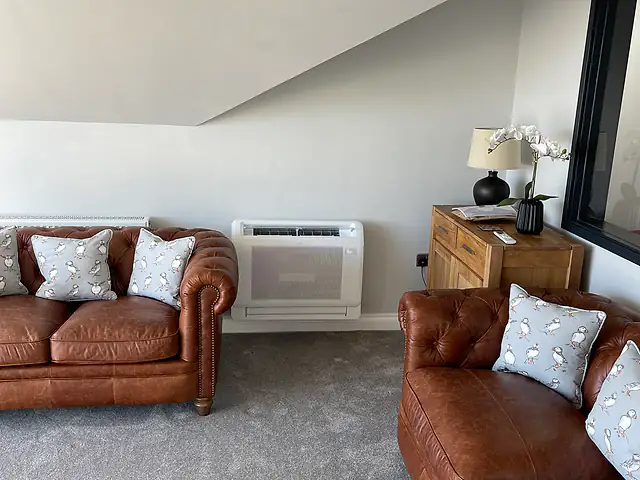
A floor-standing console air conditioner in a lounge, the kind of air conditioning we fit for homes in East London
A floor-standing console air conditioner in a lounge. An example of the air conditioning we install for homes in East London.

For homes

For homes across East London, the commonest requests are bedroom cooling in top-floor flats, a loft conversion that becomes unbearable by mid-afternoon, and a quiet unit for a home office or garden studio. We survey each room, calculate the cooling load from glazing, orientation, roof exposure and occupancy, then recommend a single split, a multi-split or, in larger houses, a concealed ducted unit. Because these are reverse-cycle heat pumps, they also heat efficiently, which suits flats relying on old storage or panel heaters. For existing systems we service, diagnose faults and give a straight view on repair versus replacement.

Domestic air conditioning
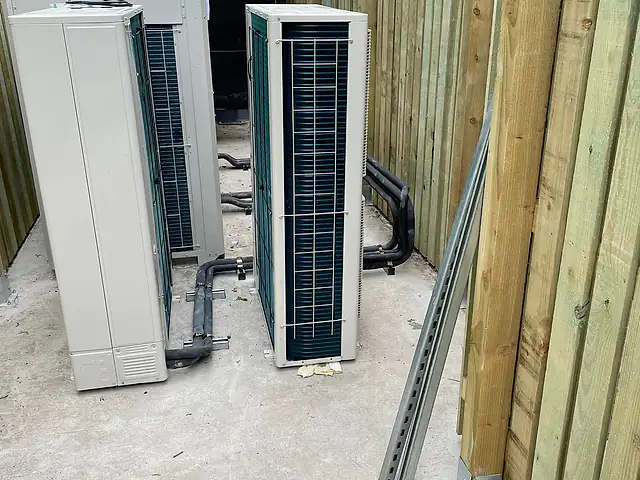

Large commercial outdoor air conditioning units in a plant area, the kind of commercial air conditioning we fit for businesses in East London
Large commercial outdoor air conditioning units in a plant area. An example of the commercial air conditioning we install for businesses in East London.

For businesses

Commercial demand across the region is broad: open-plan offices at Canary Wharf and Stratford, studios and event spaces in Hackney Wick, restaurants on Brick Lane and Green Street, clinics and gyms in Ilford and Romford, warehouses and trade counters around Beckton, Barking and Dagenham Dock. We design cassette, ducted and multi-zone systems, including VRF where a building has many zones, add dedicated cooling for comms rooms that run around the clock, and provide planned maintenance so filters, drains and refrigerant circuits are checked before the busiest weeks of summer.

Commercial air conditioning

Which Air Conditioning Suits an East London Home?

Start from the room, not the product. Count the rooms that genuinely overheat, note which way their windows face and where an outdoor unit could sit without crossing a neighbour or a lease clause. Those three answers usually point clearly to one of the system types below, and they also decide how much pipework, drilling and access equipment the job will need.

One hot room: a single wall-mounted split

A top-floor bedroom in a Leyton terrace or a south-facing living room in a Canning Town flat is the classic single-split job. A 2.5 kW or 3.5 kW inverter unit covers most rooms of that size, with a short pipe run through a core-drilled hole to a bracket-mounted condenser. Short runs keep efficiency high and costs down, and inverter compressors throttle back once the room is cool rather than cycling on and off, which keeps noise and energy use low overnight.

  • Best where only one or two rooms overheat
  • Shortest installation, often finished in a day
  • Easy to extend later with a second system

Several bedrooms, one outdoor position: multi-split

Terraced houses and semis rarely have room for three condensers, and leases or neighbours seldom welcome them. A multi-split connects two to five indoor units to one outdoor unit, each with its own controller. The trade-off is longer pipe runs, usually routed through the loft or internal voids, and a condenser that must be sized for the combined load rather than each room separately.

Routing pipework in a Victorian or Edwardian terrace

In a typical two-storey terrace the cleanest route is up into the loft, across the joists and down the rear wall in a painted trunking, so nothing appears on the street side. Each indoor unit needs a condensate drain falling to a waste or gully, or a small pump where gravity will not work.

Planning for a later loft conversion

If a loft conversion is likely within a few years, choosing an outdoor unit with a spare port and leaving capped pipework in place saves opening up finished plaster later. It is a small extra at survey stage and a large saving afterwards.

Lofts, warehouses and larger houses: ducted or floor console

Where a wall unit would spoil a room, or there is simply no suitable wall, a ducted unit hidden in a loft, bulkhead or ceiling void can feed several rooms through slim grilles. In warehouse conversions with exposed brick and concrete soffits, floor-standing consoles under the windows are often the neater choice. Both need more planning and access than a wall-mounted split, so they work best alongside other building work.

Barking and Dagenham and Havering Through This Regional Page

The two outermost East London boroughs do not have their own pages here, so this section covers them. Their housing is quite different from the inner east: more houses than flats, more gardens and driveways, and large planned estates whose uniform rows still shape where equipment can sensibly go.

Becontree and other cottage-style estate houses

The interwar Becontree estate, spread across Dagenham and parts of Barking, is made up of short terraces of modest two-storey cottages, many now privately owned. Bedrooms are compact, so a 2.0 to 2.5 kW unit is often enough, and a single outdoor unit at the rear can serve two rooms. Where a house is still council-let, the tenant will need the landlord's written permission before any wall is drilled.

Romford, Hornchurch and Upminster family homes

Havering's semis and detached houses typically have side access and rear gardens, so condensers can sit on a ground pad well away from the house next door. Larger homes in areas such as Emerson Park suit ducted systems in the loft, while extensions and conservatories need sizing for their glazing. Gidea Park includes a conservation area, where visible external equipment may need checking with the council first.

Barking town centre and Barking Riverside flats

New apartment buildings around Barking town centre and at Barking Riverside are typically managed by an agent with set rules on balconies and facades. Some include provision for cooling, others prohibit external units outright. Ask the managing agent for the building's policy and any approved positions before arranging a survey, so the design starts from what is actually allowed.

Local properties

From Becontree Cottages to Docklands Glass: Homes We Cool

Converted warehouses along the Lea and the canal

Lofts in former factories, print works and stores near the Regent's Canal, the River Lea and the old docks have tall ceilings, big steel-framed windows and solid brick or concrete soffits that cannot easily hide a duct. Floor consoles, high-wall units or a ducted unit tucked into a kitchen bulkhead are the usual answers, sized for the large air volume rather than the floor area alone.

Glass-fronted towers from Stratford to the Royal Docks

Apartments around Stratford, Canary Wharf, Canning Town, Barking Riverside and central Ilford often have full-height glazing and windows that only open a little. Solar gain on south and west faces drives most complaints. Many blocks forbid balcony condensers or nominate a plant area, and some already have a central cooling system that needs servicing rather than a new unit.

Victorian and Edwardian terraces and Warner flats

Two-storey terraces stretch from Clapton through Forest Gate to East Ham and Leyton. One condenser on the rear wall or the back-addition roof can run a multi-split serving two or three bedrooms, with pipework routed through the loft or down the rear elevation so the front of the house stays exactly as it was.

Cottage estates and interwar semis further east

Becontree's short terraces, Harold Hill's post-war houses and the semis of Gants Hill, Hornchurch and Upminster usually have rear gardens and, often, side access. That freedom makes ground-mounted condensers on anti-vibration feet practical, though shared side boundaries mean neighbours' windows still need checking before a position is fixed.

Before you install

Consents, Access and Noise Across the Eastern Boroughs

This is general guidance only. Every building, lease and planning situation is different, so we’ll talk through yours at survey stage.

  1. 01Conservation areas cluster in the inner boroughs but also appear further out, for example around Wanstead, Walthamstow Village and Gidea Park. Where a condenser would be visible from the street, you should check with your local planning authority before settling on a position.
  2. 02Most flats in the region are leasehold, whether in a converted terrace, an ex-council block or a dockside tower. The lease will usually require written consent from the freeholder or managing agent before anything is fixed to an external wall or balcony.
  3. 03Access ranges from controlled parking zones and low-traffic filters in Hackney and Walthamstow to concierge-managed loading bays on the Isle of Dogs and wide driveways in Havering. Telling us about permits, lifts and booking rules early keeps installation day on time.
  4. 04Close-packed terraces put condensers near neighbours' bedrooms. Choosing a model with a low sound power rating, using a night-quiet mode and mounting on rubber isolators all help, and noise may form part of any planning assessment.
  5. 05Older terraces and estate houses sometimes have small or ageing consumer units. A dedicated circuit with its own outdoor isolator is normally needed, so an electrical check forms part of every survey.
Pricing explained

What Pushes an East London Air Conditioning Quote Up or Down?

We do not publish prices because two East London installations of the same unit can differ widely in labour, access and materials. A written quote should list the equipment, pipe lengths, electrical work, drainage, access arrangements and commissioning separately, so you can see exactly what is driving the total and compare like with like.

Number of rooms and type of system

A single split for one bedroom is the simplest job. Each extra indoor unit adds equipment, pipework and labour, and moving to ducted or VRF adds design time, ductwork and ceiling work. Choosing efficient inverter equipment with good SEER and SCOP ratings may cost more at the outset but reduces running costs.

Height, access and the route to the condenser

A condenser on a ground pad behind a Hornchurch semi is quick to fit. One on the rear wall of a third-floor Hackney flat may need a tower scaffold or a powered access platform, and a tower block may require out-of-hours working arranged through the managing agent. All of that affects labour time.

Pipe run length and internal routing

Longer refrigerant runs need more copper, insulation and sometimes extra refrigerant. Routing through a finished loft conversion, boxing in pipework or lifting floorboards in a period house all take time, and condensate pumps add parts where a gravity drain is not possible.

Electrical supply and making good

Most systems need a dedicated circuit and an outdoor isolator. An older consumer unit may need work first. Making good plaster, decorating trunking and protecting floors in tight terraces are all included in a properly itemised quote.

Step by step

Survey to Switch-On on an East London Installation

  1. Survey and heat-load check

    We visit, measure each room, note glazing, orientation and roof exposure, and look at where an outdoor unit could go. We also check the electrics and ask about leases, conservation areas and building rules that might affect the design.

  2. Written design and quote

    You receive a recommendation with unit sizes, condenser position, pipe and drain routes and an itemised quote. If freeholder, managing agent or planning input is needed, we provide the specifications and drawings they typically ask for.

  3. Installation day

    We protect floors and stairs, core-drill, fit brackets or ground pads, run and insulate pipework, connect drainage and power, then pressure-test and vacuum the circuit before releasing refrigerant. Most single splits take a day; multi-splits take longer.

  4. Commissioning and handover

    We check pressures, temperatures and airflow, show you the controls, schedules and filter cleaning, and register the equipment with the manufacturer where applicable. Annual servicing is then recommended to keep efficiency and reliability where they should be.

FAQs

What East London Households and Firms Ask Us First

Which parts of East London do you cover?

We cover Hackney, Tower Hamlets, Newham, Redbridge and Waltham Forest, which each have their own pages, plus neighbourhoods such as Stratford, Shoreditch, Bethnal Green, Canary Wharf and Ilford. Barking and Dagenham and Havering are covered through this regional page, including Barking, Dagenham, Romford, Hornchurch and Upminster. If your address is near the Essex border, get in touch and we will confirm it.

Can air conditioning replace the heating in my flat?

Reverse-cycle split systems are air-to-air heat pumps, so they heat as well as cool, often far more efficiently than panel or storage heaters. In a well-insulated flat they can be the main heat source for the rooms they serve. In draughty older houses they usually work best alongside existing radiators. Bathrooms and hot water are not covered, so the survey looks at the whole picture.

Do I need planning permission for an outdoor unit?

Many houses can install a condenser without a full planning application, but rules depend on size, position, distance from boundaries and whether the property is listed or in a conservation area. Flats are often treated differently. It makes sense to check with your local planning authority, and leaseholders will also need consent from the freeholder or managing agent.

How loud will the outdoor unit be next to my neighbours?

Modern inverter condensers are much quieter than older fixed-speed units, and many have a night mode that lowers fan and compressor speed. Real-world noise depends on position, reflecting walls and mounting. We avoid placing units opposite bedroom windows, use anti-vibration mounts and can share manufacturer sound data if a neighbour or the council asks.

My tower block flat overheats but external units are banned. What can I do?

First ask the managing agent whether the building has a central cooling system, a designated plant area or an approved alternative. Some blocks allow through-wall units with no external condenser, which are less efficient but need no balcony space. Solar film and better ventilation help too. We can talk through options once we know the building's rules.

How often should an air conditioning system be serviced?

For homes, once a year is usually enough, ideally in spring before heavy use. Busy commercial premises, kitchens and dusty workshops benefit from more frequent visits. A service covers filters, coils, condensate drains and pumps, electrical connections and a check of the refrigerant circuit's performance, which helps avoid breakdowns during heatwaves.

Borough and Neighbourhood Pages for the East of the Capital

Free quote

Tell Us About Your East London Property and What Needs Cooling

Tell us about your home or business in East London and what you’d like to achieve, whether that’s cooling, heating or both. We’ll come back with advice and next steps.

  • Survey-led advice: recommendations based on your rooms, layout and how you use the space.
  • Clear written quotation: what’s included, the equipment proposed and the next steps.
  • No obligation: ask questions and take your time to decide.
  • CoverageHomes & businesses across Greater London

Request your free quote

A few details help us understand your property and come back with useful advice.

Fields marked * are required. We only use your details to respond to this enquiry.
Get a Free Quote

