
Areas we cover

Air Conditioning Across West London

West London runs from mansion flats beside the Thames to Metro-land semis, Wembley towers and the logistics belt around Heathrow. We design, install, service and repair air conditioning across all of it, choosing equipment to suit the building rather than forcing one system onto every property.

Free quote in West London

Homes and businesses: tell us what you need and we’ll be in touch.

One Region, Very Different Buildings: Cooling the Western Boroughs

West London is not one housing market but several stacked side by side. Inner boroughs such as Hammersmith and Fulham are dominated by tall Victorian terraces split into flats, red-brick mansion blocks and new riverside apartments. Travel out along the A40 or the Metropolitan line and the picture changes to interwar semis, bungalows and detached houses with proper gardens. Between the two sit fast-growing hubs such as Wembley Park, Brentford and the towns along the Elizabeth line, where new towers have gone up quickly.

That spread matters because the right air conditioning depends on the structure in front of you. A top-floor flat in Shepherd's Bush may only have a rear outrigger roof for the condenser, and the lease will govern whether it can go there at all. A 1930s semi in Rayners Lane or Greenford usually has a garden, a side passage and a loft that can hide pipework, so a multi-split serving three or four rooms is realistic. A glazed apartment in Wembley Park may have strict building rules that decide the answer before any engineer arrives.

Commercial demand is just as broad. Park Royal, which straddles Brent, Ealing and Hammersmith and Fulham, is one of the largest industrial areas in the capital. The Great West Road, Chiswick Business Park and Stockley Park hold corporate offices, while the land around Heathrow is packed with hotels, cargo sheds and data facilities. We cover the whole region, and the borough and neighbourhood pages linked below go into far more local detail.

Our services

Home Cooling and Business Climate Control from Fulham to Uxbridge

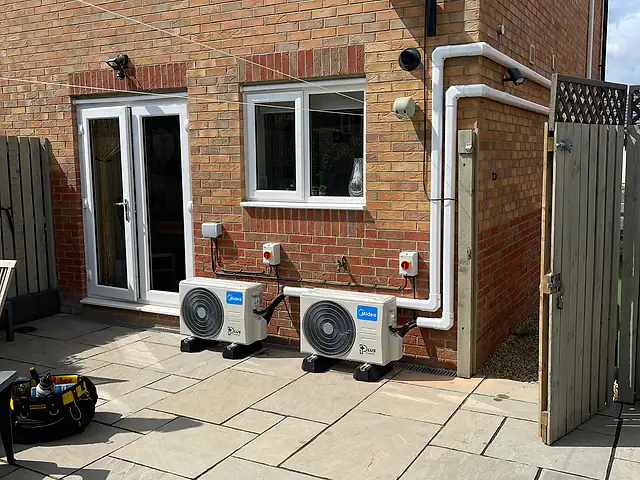
Two outdoor air conditioning units on a patio with neat trunking, the kind of air conditioning we fit for homes in West London
Two outdoor air conditioning units on a patio with neat trunking. An example of the air conditioning we install for homes in West London.

For homes

Most household enquiries across the region are about bedrooms that stay too warm to sleep in, loft conversions that bake under the roof and glazed kitchen extensions that become unusable on summer afternoons. Reverse-cycle split systems are popular because they also provide efficient heating in spring and autumn. In a Fulham or Shepherd's Bush flat that usually means one or two wall-mounted units; in a larger Pinner, Ruislip or Ealing house it may mean a multi-split or a ducted loft system. We measure rooms, check glazing and orientation, agree a condenser position and then install, commission and service the equipment.

Domestic air conditioning
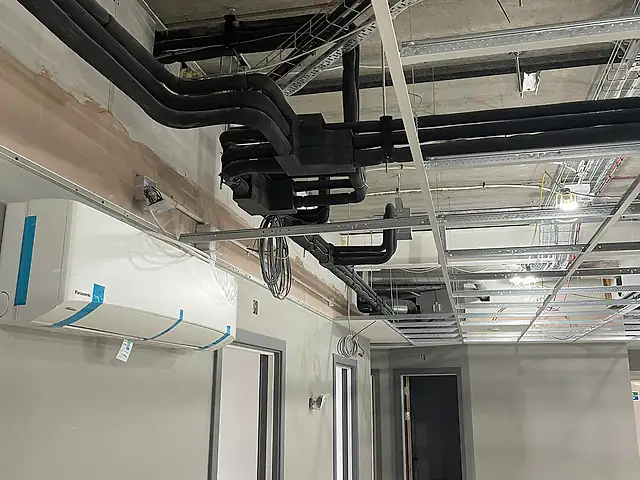

Insulated refrigerant pipework during a commercial fit-out, the kind of commercial air conditioning we fit for businesses in West London
Insulated refrigerant pipework during a commercial fit-out. An example of the commercial air conditioning we install for businesses in West London.

For businesses

Businesses here range from media studios in White City and offices on the Great West Road to food producers in Park Royal, restaurants on Southall Broadway, venues around Wembley and hotels beside Heathrow. We design and install split, multi-split, ducted and VRF systems, provide dedicated cooling for server and comms rooms, and carry out planned maintenance and repairs. In multi-let buildings we work with landlords and facilities teams on permits, roof access, out-of-hours working and the records needed for refrigerant compliance.

Commercial air conditioning

Matching the System to the Street: Inner West, Suburbs and Corridors

The quickest way to narrow down the right equipment in West London is to start with the building type and the space available outside. The three broad zones below cover most of the enquiries we receive, and each borough page explores the local variations in more depth.

Compact wall splits for inner-west flats and terraces

In Hammersmith, Fulham and Shepherd's Bush, the limiting factor is almost always where the outdoor unit can legally and practically go. A single wall-mounted indoor unit of around 2.0 to 3.5 kW suits most bedrooms, connected to a slim condenser on a rear roof or back wall. Keeping the refrigerant run under about ten metres helps efficiency and avoids long runs of visible trunking up a rear elevation.

When a twin-split makes more sense

If a flat needs a bedroom and a living room cooled, a twin-split uses one condenser for both rooms. That halves the external equipment, which freeholders and conservation officers tend to prefer, and simplifies the electrical connection to a single isolator.

Multi-splits and ducted lofts for Metro-land homes

Harrow, Hillingdon, northern Ealing and northern Brent are dominated by houses with loft space and gardens. A multi-split with three to five indoor units on one condenser is common, with pipework routed through the loft and dropped through airing cupboards or built-in wardrobes. For owners who want nothing visible on the walls, a ducted unit in the loft can feed ceiling grilles in each bedroom.

Checking pipe length and height limits

Every multi-split has a maximum total pipe length and a maximum height difference between indoor and outdoor units. In larger detached houses in Pinner, Stanmore or Northwood these limits are checked at survey, and two smaller systems sometimes outperform one large one.

Cassettes, ducted plant and VRF along the M4 and A40

Offices and industrial units around Park Royal, the Great West Road, Stockley Park and Heathrow usually need ceiling cassettes or ducted systems for open-plan floors, with VRF where many zones need independent control and heat recovery between them. Server rooms are cooled separately so that a fault in the comfort system never threatens equipment uptime.

  • Cassettes suit suspended ceilings in offices, showrooms and trade counters
  • Ducted units keep plant out of sight in reception and client areas
  • VRF can move heat from sunny elevations to shaded ones in the same building
  • Dedicated comms-room units run all year, independent of office hours

Flight Paths, Thames Frontages and Industrial Estates: Local Constraints

Some installation challenges are almost unique to this side of London. Aircraft noise, riverside sites, large industrial estates and dense controlled parking zones all influence equipment choice, siting and scheduling, and they are best dealt with at survey stage rather than on installation day.

Sleeping with windows shut under the Heathrow approaches

Large parts of Hounslow, Hillingdon and south-west Ealing sit under the arrival and departure routes for Heathrow. Households there often keep bedroom windows closed overnight, which traps heat. The answer is not simply more capacity: an inverter split that runs steadily at low fan speed, with indoor sound levels around 20 to 25 dB(A) on its quietest setting, keeps a sealed room comfortable without adding its own noise.

Riverside apartments and period homes by the Thames

From Fulham Reach and Brentford Lock to Old Isleworth, riverside buildings combine high glazing, exposure to wind and, in some places, lower-lying ground. Condensers are best mounted on brackets or raised bases, condensate needs a reliable gravity fall or pump, and in period streets the visual impact of pipework on rear elevations deserves as much thought as the cooling itself.

Working inside Park Royal and airport-side estates

Industrial landlords around Park Royal, Hayes and Feltham often require risk assessments, method statements and permits for roof work, and some estates restrict deliveries to set hours. Gathering these documents early means lifting equipment, booking access platforms and isolating electrical supplies can all happen in a single planned visit.

Out-of-hours installation for live operations

Warehouses, studios and food production sites often cannot stop for a day. Installations can be phased around shifts, with noisy core drilling and electrical isolation scheduled for evenings or weekends when fewer staff are on site.

Local properties

The Homes and Workplaces We Survey Most Often Out West

Converted terraces and mansion flats in the inner west

Hammersmith, Fulham, Shepherd's Bush and West Kensington are full of Victorian terraces divided into two or three flats, plus Edwardian mansion blocks. Usable outside space is scarce, so condensers typically go on a rear flat roof, in a lightwell or high on a back wall. Single or twin-room systems with short refrigerant runs are the norm, and freeholder consent usually comes first.

Metro-land and interwar suburbia

Large parts of Harrow, Hillingdon, northern Brent and western Ealing were built in the 1920s and 1930s as semis with hipped roofs and bay windows. Side access and rear gardens make condenser siting easy, and loft space lets pipework drop discreetly to each bedroom. A multi-split cooling the main bedrooms and a home office is the most common request.

New towers in Wembley Park, Brentford and along the Elizabeth line

Recent apartment schemes are airtight and heavily glazed, so they overheat even in late spring. Many are run by a single operator who controls balconies and facades. Some buildings include a provision for cooling; others forbid external units outright. Reading the lease or tenancy and asking the building manager is the first step.

Industrial, logistics and airport-related premises

Warehouses in Park Royal and Feltham, hotels near Heathrow and offices on the Golden Mile at Brentford need everything from ceiling cassettes and ducted systems to VRF installations and close-control cooling for comms rooms. These sites are sized on real heat loads from occupancy, lighting, servers and processes rather than floor area alone.

Before you install

Planning Points That Change from Borough to Borough Out West

This is general guidance only. Every building, lease and planning situation is different, so we’ll talk through yours at survey stage.

  1. 01Conservation areas are widespread but not uniform. Bedford Park, Brentham Garden Suburb, Harrow on the Hill, Ruislip and Northwood each have their own character appraisals, so you should check with the relevant local planning authority before placing a condenser where it can be seen from the street.
  2. 02Most flats in the inner west are leasehold. Written consent from the freeholder or managing agent is usually needed for wall penetrations, brackets and roof-mounted units, and approval can take several weeks, so start that conversation early.
  3. 03Under the Heathrow approach paths in Hounslow, Hillingdon and parts of Ealing, many households keep windows shut on summer nights. Indoor units with a genuinely quiet night mode matter more here than headline cooling capacity.
  4. 04Riverside homes from Fulham to Brentford and Isleworth can sit in lower-lying ground near the Thames. Wall brackets or raised plinths keep outdoor units and electrics clear of standing water and debris.
  5. 05Wembley event days and controlled parking zones across the inner boroughs affect when and how installers can unload, so access and parking are best agreed before an installation date is fixed.
Pricing explained

What Shapes the Price of an Installation in West London?

Quotes across the region are built from the same components: equipment, labour, materials, electrical work, access and commissioning. What changes the total is how the building and its surroundings affect each one. A semi in Ruislip and a top-floor flat in Hammersmith can need identical indoor units yet very different installation effort.

Room count and whether one condenser can serve them all

A single wall-mounted split is the simplest job. Multi-splits, ducted loft systems and VRF installations involve more equipment, longer pipework and more commissioning time. In larger suburban houses one multi-split can be more economical than several separate systems.

Pipe route, height and access to the condenser position

Long refrigerant runs, routes through several floors and condensers on high rear walls or flat roofs all add time and materials. Inner-west terraces often need scaffold towers or roof access, while suburban homes with side passages tend to be quicker.

Electrical supply and consumer unit capacity

Each system needs a dedicated circuit and a local isolator. Older consumer units in interwar houses or converted flats sometimes need upgrading before a new circuit can be added safely, which is identified during the survey.

Consents, parking and site rules

Freeholder approvals, planning checks in conservation areas, parking suspensions in controlled zones and landlord permits on industrial estates do not change the equipment, but they affect scheduling, paperwork and sometimes the condenser position, which in turn alters the pipe route.

Commercial loads and out-of-hours working

Offices, restaurants and warehouses are sized on occupancy, lighting, equipment and glazing. Evening or weekend installation to avoid disrupting trading, plus any requirement for redundancy in server rooms, are listed separately in a commercial quote.

Step by step

From First Call to Commissioning Anywhere West of Kensington

  1. Initial conversation and photos

    Tell us the borough, building type and which rooms or spaces need cooling. Photos of the rear elevation, loft and electrical consumer unit help us flag consent, access or parking issues straight away, especially for flats and industrial units.

  2. Survey and heat-load check

    An engineer measures rooms, notes glazing, orientation and insulation, checks condenser positions and pipe routes, and confirms electrical capacity. For commercial sites we also look at occupancy, equipment heat and any landlord or estate rules.

  3. Written proposal and consents

    You receive a clear quote describing equipment, positions and what is included. If freeholder approval, a planning check or an estate permit is needed, we can supply equipment details and drawings to support the application.

  4. Installation, commissioning and aftercare

    Units are fitted, pipework pressure-tested and evacuated, refrigerant charge checked and controls set up. We explain operation and filter cleaning, then offer annual servicing so the system stays efficient through West London summers.

FAQs

Questions Westside Households and Businesses Ask Before Booking

Which parts of West London do you cover?

We cover the London Boroughs of Ealing, Hounslow, Hillingdon, Brent, Harrow and Hammersmith and Fulham, plus Richmond upon Thames and Kingston upon Thames. That includes town centres such as Uxbridge, Harrow, Wembley, Ealing Broadway, Chiswick and Fulham, as well as quieter suburbs and the industrial and airport-side areas. If you are close to a boundary and unsure, simply ask.

Is air conditioning worthwhile in the outer suburbs as well as inner West London?

Outer suburbs such as Ruislip or Pinner cool down slightly more at night than Hammersmith or Shepherd's Bush, but bedrooms under hipped roofs, loft conversions and south-facing extensions still overheat in hot spells. Suburban houses are often easier to install in because of gardens and loft space, and reverse-cycle heating in spring and autumn spreads the value across the year.

Can I install air conditioning in a leasehold flat in Hammersmith or Fulham?

Usually it is possible, but the lease normally reserves the external walls and roof to the freeholder, so written consent is needed before any condenser or core hole. Mansion blocks and managed new builds may have specific approved positions. Start with the managing agent; once you know what is allowed, we can propose an indoor unit and outdoor location that fits within those rules.

Will aircraft noise affect which unit I choose near Heathrow?

It mainly affects how you use the system. If you keep windows closed at night because of aircraft, the indoor unit runs for long hours in a quiet room, so its lowest sound level and night mode matter. An inverter model sized correctly will run gently rather than cycling on and off, and the outdoor unit should still be sited away from neighbours' bedrooms.

Do you handle commercial projects in Park Royal and around the airport?

Yes. We install and maintain cooling for offices, warehouses, studios, hotels and comms rooms in Park Royal, Feltham, Hayes, Stockley Park and the wider Heathrow area. Surveys look at internal heat loads, roof or wall access and estate rules, and work can be phased around shifts so production, deliveries and guests are disrupted as little as possible.

How often should a West London system be serviced?

For homes, once a year is usually sensible, ideally in spring before the first hot spell. Offices, shops and restaurants with long running hours, kitchens or dusty environments such as industrial estates and busy roads like the A40 or Great West Road may need servicing every six months. Server-room units are often checked quarterly because they run continuously.

Free quote

Tell Us About Your West London Property and Cooling Needs

Tell us about your home or business in West London and what you’d like to achieve, whether that’s cooling, heating or both. We’ll come back with advice and next steps.

  • Survey-led advice: recommendations based on your rooms, layout and how you use the space.
  • Clear written quotation: what’s included, the equipment proposed and the next steps.
  • No obligation: ask questions and take your time to decide.
  • CoverageHomes & businesses across Greater London

Request your free quote

A few details help us understand your property and come back with useful advice.

Fields marked * are required. We only use your details to respond to this enquiry.
Get a Free Quote

