

Efficiency restored
Clean filters, coils and fans let the system move heat freely again, so rooms reach temperature faster and the compressor spends less time at full output.
A service is one structured visit in which an engineer cleans the indoor and outdoor units, checks the drainage and electrics, measures refrigerant pressures and air temperatures, and records the results, so your system starts the season clean, efficient and fault-free.
Arrange a Service
Tell us about your property and we’ll come back with advice and a written quote.
Air conditioning collects dirt in places you cannot see. Filters catch the larger dust, but fine particles still reach the indoor coil and fan, the drain tray gathers sludge, and the outdoor coil slowly clogs with grime, pollen and leaves. Each of these reduces airflow and heat transfer, so the system works harder for the same result, uses more electricity and becomes more likely to fail on the hottest day of the year.
A professional service reverses that decline and gives an engineer the opportunity to measure how the system is performing. We service wall-mounted, floor console, cassette, ducted and multi-split systems in homes, rental properties, offices, shops, restaurants and equipment rooms across Greater London, following a consistent checklist adapted to the equipment on site.
This page sets out exactly what a service covers, how often different types of property should book one, the warning signs that a service is overdue and how refrigerant leak-check rules relate to servicing. If you are looking for an ongoing programme of scheduled visits and records across a building or estate, our maintenance page explains planned contracts; if the system has already failed, see repairs.
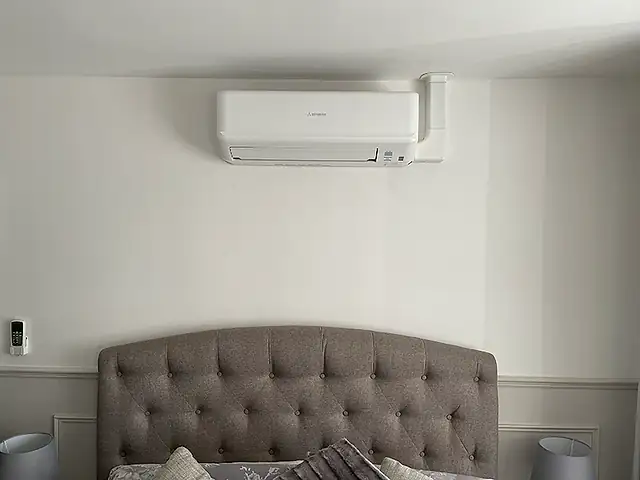
A compact wall-mounted air conditioner above a bed, a typical setup for air conditioning servicing in London.
A service has two jobs. The first is cleaning: removing the dust, grime and biological growth that reduce airflow, insulate the coils and block the drain. This restores much of the efficiency a system loses through ordinary use, and it is often enough to clear smells and reduce noise on its own.
The second job is inspection and measurement. With the system clean, the engineer can see whether it is performing as it should. Supply and return air temperatures, refrigerant pressures and electrical readings reveal problems that cleaning alone will not fix, such as a slowly falling refrigerant charge, a fan motor drawing more current than normal or a capacitor that is weakening.
Recording those readings at each visit turns a one-off service into a useful history. A gradual change between one year and the next is often the first sign of a developing fault, and spotting it early gives you the choice of addressing it at a convenient time rather than during a breakdown.
Clean filters, coils and fans let the system move heat freely again, so rooms reach temperature faster and the compressor spends less time at full output.
Loose terminals, weakening capacitors, slow drains and worn fan bearings are cheaper to deal with when found during a service than after they cause a breakdown.
Cleaning and treating the coil, fan and drain tray removes the build-up that causes musty odours when the unit starts after a quiet spell.
Recorded temperatures, pressures and electrical readings let future engineers compare results visit to visit and spot gradual decline before it becomes a failure.
Balanced fans, tightened panels and clean blades reduce the rattles and hums that build up over time in both indoor and outdoor units.
Many manufacturers expect systems to be serviced regularly, and a dated service record is useful evidence if you ever need to make a warranty claim with them.
Our service checklist covers the indoor unit, the outdoor unit, the drainage, the electrics and the refrigerant circuit. The exact tasks vary with the type of equipment, but the aim is always the same: nothing important left unchecked and every finding written down.
Filters are removed, cleaned and checked for damage. The evaporator coil is cleaned with a suitable coil cleaner and rinsed, and the fan barrel or blower wheel is cleaned to restore airflow and reduce imbalance. Louvres, swing motors, casings and the controller are checked so the unit directs air correctly and responds to commands. Any specialist filters, such as those found on some cassettes, are cleaned or replacement advised.
The drain tray is cleaned of sludge and the condensate line flushed to confirm water flows freely to its outlet. Where a condensate pump is fitted, it is tested by introducing water and checking it starts, discharges and stops correctly, and its safety float switch is checked. A drain that runs slowly today is the leak of next summer, so this part of the service is never skipped.
The condenser coil is cleaned to remove dirt, leaves and traffic grime, taking care not to flatten the fins. The fan blade is checked for damage and secure fixing, and the motor is listened to for bearing wear. Brackets, wall fixings and anti-vibration mounts are inspected for corrosion and security, and the area around the condenser is cleared so air can circulate freely.
Terminals are checked for tightness and signs of overheating, and cables, isolators and controls are inspected. With the system running, the engineer measures current draw, supply and return air temperatures and operating pressures, and compares them with expected values for the model and conditions. Pipe insulation and visible joints are inspected for damage or oil staining that could indicate a leak.
The difference between the air entering and leaving the indoor unit is a quick indicator of how well the system is moving heat. A smaller difference than expected, after cleaning, suggests a refrigerant, airflow or component issue that warrants further investigation.
Connecting gauges releases a small amount of refrigerant each time, so many engineers rely on temperature readings where possible and connect gauges only when the evidence suggests it is necessary. Either way, the readings are recorded on the service sheet.
There is no single interval that suits every system. How many hours a unit runs, whether it heats as well as cools, and how dusty or greasy the surrounding air is all affect how quickly it needs attention. The manufacturer's guidance for your model is a sensible baseline.
For most domestic systems used mainly in summer, a service once a year is a reasonable baseline, ideally in spring before heavy use begins. Homes that use air conditioning as a primary heat source through winter, or that have pets, nearby building work or heavy traffic outside, may benefit from a second visit in autumn. Landlords often align servicing with tenancy changes so the system is clean and documented for new occupants.
Commercial systems typically run longer hours in both modes and deal with more occupants, dust and, in hospitality, airborne grease. Twice-yearly servicing is common, with a spring visit before cooling season and an autumn visit before heating takes over. Busy kitchens, gyms and salons may need more frequent filter cleaning between visits because filters load up quickly in those environments.
Cooling for IT equipment often runs around the clock, all year, and a failure can lead to overheating within a short time. These systems are commonly serviced quarterly, with closer attention to filters, condenser cleanliness, drainage and any duty and standby changeover. Checking that alarms and controls work is as important as cleaning, because they are what warn you when cooling is lost.
A system rarely fails without some advance warning. If you notice any of the signs below, booking a service sooner rather than later can stop a minor issue turning into a repair.
If rooms take noticeably longer to reach the set temperature, or the airflow from the indoor unit feels weaker than it used to, dirty filters and a coated coil or fan are the usual suspects. The unit may also run for longer periods and rarely throttle back. A clean usually restores performance, and the measurements taken afterwards confirm whether anything else is wrong.
A musty smell when the system starts, occasional drips from the indoor unit or a gurgling sound from the drain all suggest the drain tray and condensate line need cleaning. Rattling or humming from the outdoor unit can mean loose panels or a fan beginning to wear. These are the kinds of problems a service is designed to catch while they are still minor.
Rising electricity use without any change in how the system is used often points to reduced efficiency. Equally, if you cannot remember when the system was last serviced, or you have moved into a property with air conditioning and no paperwork, it is sensible to book a service to establish a baseline of its condition and performance.
As general background, UK F-Gas regulations set out leak-checking duties for equipment containing fluorinated refrigerants above certain thresholds. These rules sit alongside servicing rather than replacing it, and the responsibility lies with the equipment operator, which is usually the owner or the business in control of the system.
Under current rules, systems containing refrigerant equal to or above 5 tonnes of CO2 equivalent require periodic leak checks by a certified person, with the frequency increasing for larger charges. Whether a system crosses that threshold depends on both the refrigerant type and the charge in kilograms, because refrigerants such as R410A have a higher global warming potential than R32. Many small single-room domestic units fall below the threshold; larger multi-split and commercial systems often do not.
Operators of equipment subject to leak checks are expected to keep records of the refrigerant type and quantity, checks carried out, any leaks found and repairs made. Combining the leak check with a service visit is efficient and keeps paperwork in one place. Regulations are periodically updated, so it pays to confirm current requirements for your equipment rather than relying on older guidance.
In the UK, anyone who leak checks, installs, services or repairs equipment containing F-Gas refrigerants must hold the appropriate F-Gas qualification, and businesses doing so must hold company certification. It is always reasonable to ask any engineer to confirm theirs.
Most domestic systems benefit from an annual spring service so bedrooms and living areas are ready for the first warm spell, with a second visit worth considering where units heat through winter.
Servicing between tenancies keeps systems clean for new occupants and gives landlords and agents dated paperwork showing the equipment has been looked after.
Longer running hours and higher occupancy load filters and coils quickly. Twice-yearly visits timed before cooling and heating seasons are common for workplaces and shops.
Equipment rooms running constantly and kitchens dealing with airborne grease need more frequent attention, closer drain checks and, for IT spaces, testing of alarms and changeover controls.
A service is usually priced according to how long the visit will take and what it needs to include. The more accurately you can describe your system when booking, the more accurate the quote. These are the main factors that make one service visit take longer than another.
A single wall-mounted indoor unit is quickest to service. Each additional unit adds time, and ceiling cassettes and concealed ducted units take longer because panels, grilles or ceiling tiles must be removed and the coil and drain are harder to reach. Multi-split systems are priced by the number of indoor heads as well as outdoor units.
A system serviced regularly is usually straightforward to clean. One that has gone several years without attention may need extended coil cleaning, more extensive drain clearance or a deep clean of the fan barrel, which takes longer. The first service on a neglected system is often the most involved.
Condensers at ground level or on an accessible balcony are easy to service. Units on roofs, high wall brackets or in light wells may need ladders, access equipment or building management arrangements, all of which can extend the visit.
Where a system falls under F-Gas leak-check rules, the check and its record can be combined with the service visit, adding a little time. Commercial clients who need detailed reports for building files or compliance purposes may also require more documentation than a domestic service sheet.
Servicing several systems at one address in a single visit is more efficient than separate appointments. Visits outside normal working hours, for example to avoid disturbing a shop or office, may be priced differently from standard weekday appointments.
Let us know how many indoor and outdoor units there are, the type of each, where the condenser is and when the system was last serviced, so we can allow the right time.
The engineer runs the system, notes any error history, listens for unusual noises and takes initial readings so the condition before cleaning is recorded.
Filters, coils, fan barrels, drain trays and condensate lines are cleaned, and the outdoor coil and surrounding area are cleared to restore airflow.
Electrical connections, mountings, insulation and joints are inspected, then temperatures, pressures and current draw are measured in cooling and heating modes.
You receive a record of the work carried out and the readings taken, with clear notes on anything worth monitoring or addressing before the next service.
Outdoor units in London face a steady diet of traffic pollution, brake dust, construction debris and pollen from street trees. This fine grime coats condenser fins and is often greasier than ordinary dust, so it does not simply blow away. Condensers on busy roads, near railway lines or beside building sites typically need more thorough cleaning than those in quieter back gardens.
Many condensers are also squeezed into tight spaces: light wells, narrow side returns, behind screens on flat roofs or in courtyards shared with other plant. Restricted airflow in these positions makes a clean coil even more important, because the unit already has less air to work with. Leaves and litter collecting around the base are a common finding in autumn.
Demand for engineers tends to rise sharply with the first hot spell, so booking a service in spring is the easiest way to secure a convenient date. For flats and managed buildings, check in advance whether roof or plant-area access needs arranging through the building manager, and let us know about parking restrictions or permit zones so the visit is not delayed.
This is general guidance rather than legal advice. Requirements vary by building, lease and local authority.
Local guidance by region
We cover homes and businesses across Greater London. Each region page explains local building types and consents.
Borough pages
Most homes using air conditioning mainly for summer cooling are well served by an annual service, ideally in spring. Systems used year-round for heating and cooling, or in offices and shops, often benefit from twice-yearly visits. Server rooms and other critical cooling are commonly serviced quarterly. Your manufacturer's guidance and the conditions around the unit will help decide the right interval.
A full service covers cleaning filters, the indoor coil and fan, the drain tray and condensate line, testing any condensate pump, cleaning the outdoor coil, checking fans, mountings and electrical connections, and measuring temperatures, pressures and current draw. The engineer also inspects pipe insulation and joints for signs of leaks, then records the findings and any recommendations.
Servicing a single wall-mounted indoor unit and its outdoor condenser commonly takes around an hour, depending on condition and access. Cassettes, ducted units and multi-split systems with several indoor heads take longer. A system that has not been serviced for several years may need extra cleaning time on its first visit. We will give an idea of timing when you book.
Not quite. A service is a single, hands-on visit to clean, inspect and test a system. Maintenance usually refers to a planned programme that schedules regular service visits, keeps records across the year, covers routine filter cleaning in between and plans for wear parts. Many households book one service a year, while businesses with several systems often prefer a maintenance arrangement.
Common signs include weaker airflow, rooms taking longer to cool or heat, a musty smell on start-up, dripping or gurgling from the indoor unit, new rattling or humming noises, and higher electricity use without any change in how you use the system. If you have no record of when it was last serviced, that alone is a good reason to book one.
It depends on the refrigerant type and how much the system contains. Under current UK rules, equipment holding 5 tonnes of CO2 equivalent or more must be leak checked periodically by a certified person, with records kept. Many small domestic units fall below that level, while larger multi-split and commercial systems often exceed it. An engineer can work out where your system sits.
You can and should clean the removable filters every few weeks during heavy use, which helps airflow and efficiency. A full service is different: cleaning the coils and fan properly, clearing drains, checking electrical connections and measuring refrigerant performance needs tools, training and, for refrigerant work, F-Gas certification. Do not use a pressure washer on the outdoor coil, as it can flatten the fins.
Moisture collects on the indoor coil and in the drain tray during cooling, and over time dust and biological growth build up there. When the fan starts, it carries that odour into the room. A service cleans and treats the coil, fan and drain tray, which usually clears the smell. If it returns quickly, the drain may be holding standing water.
Spring is ideal for systems used mainly for cooling, because the unit is clean and checked before the first hot spell and engineers are generally easier to book than in summer. Systems used for winter heating benefit from an autumn visit too. For businesses, scheduling around quieter trading periods or outside working hours can reduce disruption.
Planned preventative maintenance programmes with scheduled visits, asset registers, leak-check logs and filter routines for homes, landlords and multi-site businesses.
Learn more
Symptom-led fault finding for air conditioning that has stopped cooling, is leaking, icing up, tripping the electrics or showing an error code anywhere in London.
Learn more
Quiet, discreet air conditioning for London flats and houses, planned room by room, with efficient heat pump heating for the cooler months.
Learn more
Zoned cooling and heating for open-plan floors, meeting rooms and comms rooms, designed around occupancy, IT heat and your lease, and fitted around working hours.
Learn moreShare a few details about your property and what you need, and we’ll respond with advice and the next steps for your air conditioning servicing.
A few details help us understand your property and come back with useful advice.