
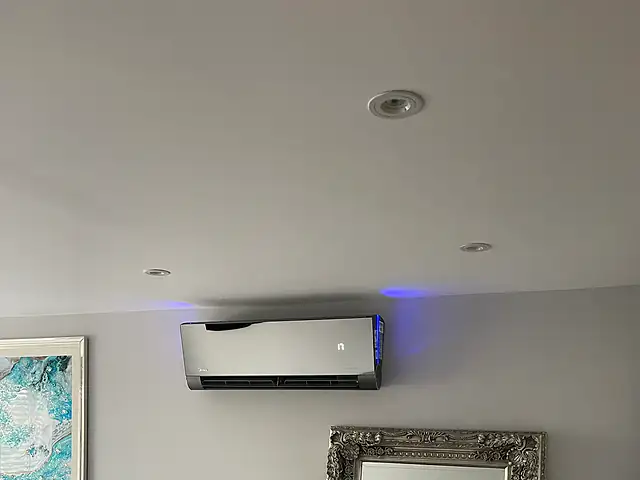
Deeper sleep in heatwaves
A steady bedroom temperature makes it easier to fall asleep and stay asleep, particularly on top floors and in loft rooms that remain warm into the small hours long after the evening has cooled outside.
A bedroom that is still warm at midnight costs you sleep. We fit quiet split system air conditioning in bedrooms, loft rooms and flats across London, choosing units by their real noise figures, placing them so air never blows across the bed, and sizing them to tick over gently all night.
Get a Bedroom Quote
Tell us about your property and we’ll come back with advice and a written quote.
Bedrooms are usually the warmest rooms in a London home just when you need them coolest. Heat rises through the house, roofs and top-floor ceilings soak up sun all day, and many bedrooms face the garden side where afternoon sun is strongest. By bedtime the walls and ceiling are releasing that stored warmth, so the room stays stuffy for hours. Opening the window helps a little, but brings in traffic noise, night buses, street lighting and, for hay fever sufferers, pollen.
Fans move warm air around without lowering its temperature, and portable air conditioners are a poor fit for sleep: the compressor sits in the room with you, and the exhaust hose leaks heat back through the window gap. A fixed split system places the compressor outside and leaves only a slim, quiet indoor unit in the room, which can cool, dehumidify and, in winter, heat.
When we plan bedroom air conditioning, three things come first: how quiet the indoor unit is at the speeds it will actually run overnight, where the air will go relative to the bed, and whether the unit is sized to run steadily at low output rather than blasting and stopping. Get those right and the system fades into the background.
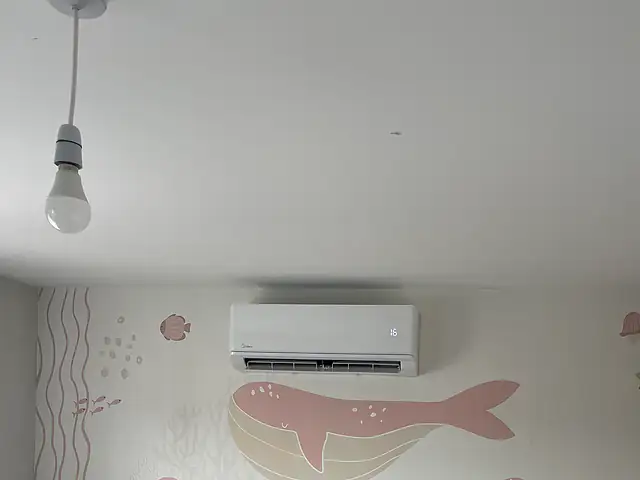
A quiet air conditioning unit in a child’s bedroom, a typical setup for bedroom air conditioning in London.
Manufacturers quote indoor unit noise as a sound pressure level in dB(A), usually measured about one metre from the unit under test conditions, for each fan speed. The A-weighting adjusts the figure to reflect how sensitive human hearing is to different frequencies. Decibels are logarithmic, so a 10 dB(A) increase is perceived as roughly twice as loud, and even a 3 dB(A) difference is noticeable in a quiet bedroom.
For context, around 20 dB(A) is close to rustling leaves or a very quiet recording studio, 30 dB(A) is a whisper or a quiet bedroom at night, and 40 dB(A) is similar to a quiet library or a fridge humming nearby. The quietest wall-mounted units list figures around 19 to 22 dB(A) on their lowest or silent fan setting, rising into the high thirties or forties on high speed. The figure that matters for sleep is the low and silent speed, because that is where a well-sized unit will spend most of the night.
Published figures are a useful comparison, but real rooms differ. Hard floors, bare walls and a unit mounted close to the headboard all make it seem louder, while carpets, curtains and a few extra metres of distance soften it. Sound pressure falls with distance, so placement is part of the noise solution. We also watch for quieter but more irritating sounds: a condensate pump cycling, louvres clicking as they swing, or a display that lights up the room.
A steady bedroom temperature makes it easier to fall asleep and stay asleep, particularly on top floors and in loft rooms that remain warm into the small hours long after the evening has cooled outside.
Cooling without opening the window keeps out traffic, sirens, street lighting, insects and pollen, a real advantage in busy parts of London and for anyone who suffers with hay fever in early summer.
With the compressor outside, a split system indoor unit at low speed can be quieter than a whisper, and there is no exhaust hose wedged in the window letting heat and noise back into the room.
Air conditioning removes moisture as it cools, so muggy nights feel fresher at a moderate set point. A dry mode handles humid nights when the temperature is only slightly too high.
As a reverse-cycle heat pump, the same unit warms the room quickly on cold mornings, which is especially useful in loft conversions and extensions where radiators struggle to keep up.
Start cooling before bedtime from your phone, let the sleep mode ease off overnight and have the unit switch off automatically in the early hours, so it only runs when you need it.
A draught across the face is the quickest way to put someone off bedroom air conditioning. Most of the comfort comes from where the indoor unit sits and how its louvres are set, which is decided at the survey, not after the unit is on the wall.
The ideal position is usually on a wall that lets the unit blow along the length of the room or across the foot of the bed, rather than directly over the headboard or straight at the pillows. Mounting high on the wall, with clear space in front for air to travel along the ceiling, allows cool air to mix before it drops into the room. We take wardrobes, curtains, radiators and the bed’s likely position into account, because furniture blocking the airflow can bounce air back down towards you.
Many current units have independently adjustable horizontal and vertical louvres, and some offer a comfort airflow setting that directs air towards the ceiling in cooling mode so it settles gently rather than streaming. Sleep or night modes typically reduce the fan to its lowest speed, dim or switch off the display, and nudge the set point up by a degree or two over the first hours, matching the natural fall in body temperature during sleep.
Many people sleep comfortably around 18 to 21°C. Setting a very low temperature makes the unit run harder and louder and can leave you waking cold. A moderate set point with dehumidification often feels cooler than the thermostat number suggests.
Correct sizing is as much about noise as temperature. An oversized unit cools quickly, then cycles and dries the air; an undersized one runs at high fan speed for hours. The aim is a unit that holds the room at low output for most of the night.
A standard double bedroom on a middle floor, with modest windows and rooms above, is often well served by the smallest units on the market, typically around 2 to 2.5 kW of cooling. These small inverter units can modulate down to a fraction of their rated output once the room is cool, which is exactly what you want overnight. Rooms with large west-facing windows or a lot of electronics may need a little more.
Loft rooms combine sloping ceilings close to the roof covering, dormers and rooflights, and often limited insulation in older conversions. Rooflights admit strong sun directly onto the floor and bed, and the roof itself radiates heat into the evening. These rooms commonly need more capacity than their floor area suggests, around 3.5 kW is not unusual for a large loft suite, and the indoor unit often has to go on a gable or a short knee wall, which shapes the airflow plan.
In loft rooms, refrigerant pipework and condensate can often run through the eaves void behind knee walls and exit at roof level or down a gable. This keeps internal trunking to a minimum but needs safe access and proper insulation of the pipes.
Fitting reflective blinds to rooflights cuts direct solar gain, which can reduce the cooling needed and help the unit run more quietly at lower speed. They are a simple, inexpensive complement to air conditioning in loft bedrooms.
Where two to four bedrooms need cooling, a multi-split can serve them from a single outdoor unit, each with its own remote and set point. This saves wall space outside, which helps in terraced houses and flats. The trade-off is that pipe routes to each room must converge on one location, and a fault on the outdoor unit affects all rooms, so single splits are sometimes the better choice.
Every air conditioner removes moisture from the air when cooling, and that water must go somewhere. How the condensate is drained has a direct effect on bedroom noise, so it deserves as much thought as the unit itself.
Wherever possible, the condensate pipe runs downhill from the indoor unit through the wall to an outside drain, gully or rainwater pipe, with no moving parts at all. On an external wall with the unit mounted high, this is usually straightforward. Gravity drainage is silent, reliable and needs only an occasional check that the pipe is clear and the outlet is not blocked by leaves.
If the unit sits on an internal wall, below the level of the nearest drain, or the pipe has to rise before it can fall, a small condensate pump lifts the water. Pumps switch on intermittently as water collects, and in a silent bedroom that hum or click can be noticeable. Mini pumps hidden in trunking or the unit casing vary in noise level, and a remote-mounted pump in an adjacent cupboard or loft is often quieter for sleepers.
Much of London’s bedroom cooling demand comes from flats, where the outdoor unit and pipe route are rarely yours alone to decide. Planning these early avoids an installation that is technically sound but cannot go ahead.
In a leasehold flat, external walls, roofs and communal areas normally belong to the freeholder, so drilling through a wall, fixing an outdoor unit to the building or running pipes across a façade usually needs written permission. Some leases prohibit external equipment altogether, while others allow it with conditions on position, appearance and noise. Reading the lease and contacting the managing agent before booking the installation saves time; we can provide a proposed layout and unit data sheets to support the request.
Common positions for flats include a balcony floor or wall, a flat roof above or nearby, a rear light well or a garden-level bracket with a longer pipe run. Each has trade-offs for airflow, access for future servicing and noise towards neighbours’ bedroom windows. Outdoor units need space to breathe; tucking one into a tight corner of a balcony can reduce efficiency and raise its noise level.
Outdoor units often run overnight when the street is quiet and neighbours sleep with windows open. Choosing a model with a low published sound power level, a night quiet mode, anti-vibration feet or brackets and a position away from adjoining windows all help. Where homes are in conservation areas or listed, visible outdoor units may need planning permission, so you should check with your local planning authority.
Flats directly beneath a roof absorb heat through the ceiling all day. A compact wall unit can transform them, provided there is a workable outdoor position and the freeholder or managing agent agrees to the proposal.
Sloping ceilings, dormers and rooflights make loft bedrooms some of the hottest rooms in a house. Units usually go on a gable or knee wall, with pipework routed through the eaves void where practical.
Parents often want a stable temperature for a child. Quiet units with dimmable displays, lockable remotes or app control, and airflow directed well away from the cot or bed suit these rooms well.
A spare bedroom used as a home office through the day and a guest room at night benefits from one unit that handles both. Daytime IT heat and overnight comfort can be managed with separate timer settings.
Bedroom installations are usually among the simpler air conditioning jobs, but the details still vary considerably. A quote should set out the equipment, the length and route of pipework, drainage method, electrical work and any access requirements, so you can see exactly what you are paying for.
The quietest premium indoor units, with very low silent-mode figures, better sensors and app control, usually cost more than entry-level models. For a bedroom, paying for a genuinely lower dB(A) rating is often the best place to spend, as it is the thing you notice every night.
A back-to-back installation, where the outdoor unit sits directly outside the bedroom wall, is the simplest. Longer runs through other rooms, lofts or down the outside of a building need more pipework, trunking and labour, and very long runs can require extra refrigerant.
Ground-level or balcony positions are straightforward. Outdoor units on high walls or roofs of upper-floor flats may need scaffolding, a tower or a cherry picker, which can make access a significant part of the cost, especially on taller London terraces.
Gravity drainage is simplest; a quiet condensate pump, remote pump location or longer drain route adds parts and time. A dedicated circuit and isolator are normally needed, and older consumer units sometimes require upgrading before a new circuit can be added.
Cooling one bedroom with a single split is the most direct option. Several bedrooms on a multi-split share one outdoor unit but need more complex pipe routes, while separate splits may be simpler but need more outdoor space. The best value depends on layout.
We measure the room, check window orientation, roof exposure and insulation, note where the bed and furniture sit, and look at external walls, balconies or roofs that could take the outdoor unit.
We recommend models by their low and silent-speed dB(A) figures and capacity, explaining sleep modes, display dimming, airflow options and app control so you can compare them properly.
We fix the indoor unit position to keep airflow off the bed, plan the shortest tidy pipe route, decide between gravity drainage and a quiet pump, and confirm the outdoor unit location.
We protect flooring and furniture, core drill the wall, mount the indoor and outdoor units, connect pipework, drainage and a dedicated electrical supply, then pressure test and evacuate the system.
After commissioning we set louvres, sleep mode and timers with you, check drainage and noise levels at low speed, and show you how to clean filters and use the remote or app.
London’s Victorian and Edwardian terraces often have main bedrooms at the front facing the street and smaller ones over the rear extension. Front bedrooms suffer most from traffic noise, which is why people keep windows shut, while rear rooms and loft conversions catch the afternoon sun. Outdoor units are usually easiest at the back, on the rear wall or a flat extension roof, with pipework running internally or along the rear elevation to front rooms.
Mansion blocks and converted period flats tend to have strict leases and managing agents who take a close interest in external equipment, especially on street-facing elevations. Rear light wells and roofs are frequently the only acceptable positions. Many newer apartment buildings were designed with high levels of glazing and airtightness, and some bedrooms overheat even with ventilation systems running; their leases may specify exactly where, or whether, outdoor units can be placed.
Across all of these, night-time noise is the issue most likely to concern neighbours and councils. Rear gardens in terraced streets are close together, and a unit running at 2am is more noticeable than the same unit at noon. Choosing a quiet outdoor unit, using its night mode and placing it thoughtfully are the best ways to keep both your sleep and your neighbours’ undisturbed.
This is general guidance rather than legal advice. Requirements vary by building, lease and local authority.
Local guidance by region
We cover homes and businesses across Greater London. Each region page explains local building types and consents.
Borough pages
The quietest wall-mounted indoor units list around 19 to 22 dB(A) on their lowest or silent fan speed, roughly the level of rustling leaves. In practice, a well-sized inverter unit spends most of the night at low speed. Room furnishings, distance from the bed and any condensate pump also affect what you actually hear.
It should not if the unit is placed and set up well. We position the indoor unit so air travels along the ceiling and away from the bed, then set the louvres to a fixed upward angle. Sleep modes lower fan speed and ease the temperature through the night, so you feel gently cool rather than a draught.
It is a sound pressure level adjusted to match how human hearing responds to different frequencies. Because the scale is logarithmic, a rise of 10 dB(A) sounds roughly twice as loud, and a 3 dB(A) difference is noticeable in a quiet room. Compare units at the same fan speed and measurement distance for a fair comparison.
For sleep, almost always. Portable units keep the compressor in the room, so they are much louder, and the exhaust hose lets heat back in through the window gap. A split system puts the compressor outdoors, runs far more efficiently and leaves the floor clear, though it needs proper installation and a suitable outdoor position.
Not all bedrooms need one, as gravity drainage through an external wall is silent and preferred. Where a pump is needed, quieter models exist, and mounting it on anti-vibration pads or in an adjacent cupboard or loft space reduces the chance of hearing it. We discuss this at survey stage because it matters for light sleepers.
Many bedrooms are well served by units of around 2 to 2.5 kW cooling, the smallest sizes available. Loft rooms with rooflights, top-floor rooms under a roof or rooms with large west-facing windows may need more. Correct sizing lets the unit run quietly at low speed, so a survey is worth more than a rule of thumb.
Yes. Modern split systems are reverse-cycle heat pumps, so the same unit can warm the room efficiently, typically delivering several units of heat for each unit of electricity. This is useful in loft conversions and extensions where the central heating struggles, and for warming a bedroom quickly before you get up.
Often you can, but you will usually need consent from your freeholder or managing agent because the outdoor unit and pipework affect the building’s exterior. Some leases restrict external equipment entirely. Check your lease and contact the managing agent early; we can provide unit details, noise figures and a proposed layout to support your request.
Used sensibly, yes. Keep the set point moderate rather than very cold, direct airflow away from the cot or bed, and clean filters regularly so dust is not recirculated. Many parents use a timer or app to monitor and adjust the room without going in. Lockable remotes stop little hands changing settings.
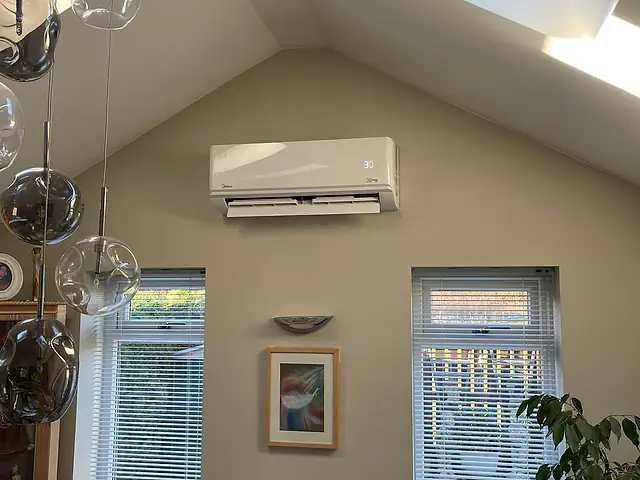
Quiet, discreet air conditioning for London flats and houses, planned room by room, with efficient heat pump heating for the cooler months.
Learn more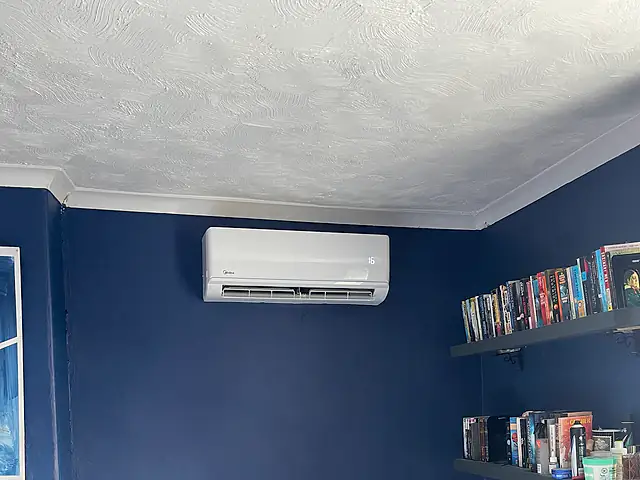
One outdoor unit paired with one indoor unit (wall-mounted, console, cassette or ducted), sized in kW for the room it serves, for quiet cooling and efficient heating.
Learn more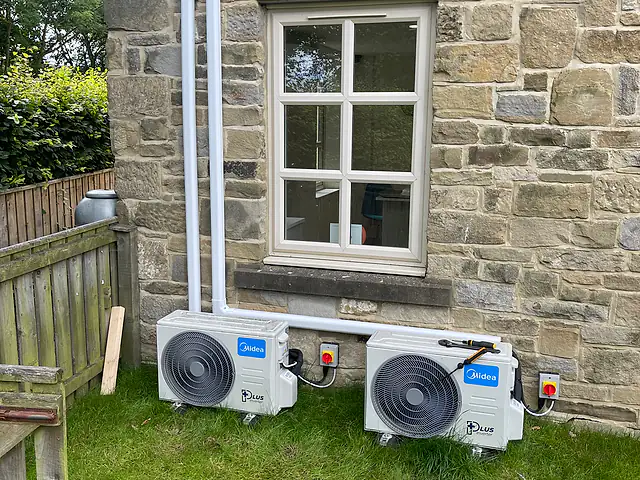
One outdoor unit running two to five indoor units, ideal when several rooms need cooling and heating but there is space or consent for only one condenser.
Learn more
Surveyed, heat-load sized and properly commissioned air conditioning for London homes and businesses, from a single wall unit to multi-room and ducted systems.
Learn moreShare a few details about your property and what you need, and we’ll respond with advice and the next steps for your bedroom air conditioning.
A few details help us understand your property and come back with useful advice.