
North London

Air Conditioning for Highgate Homes and Businesses

Highgate sits high above the city where Camden, Haringey and Islington meet, with listed village houses, celebrated modernist flats and busy Archway Road frontages. We design, install and service air conditioning that suits each of them.

  • N6

Free quote in Highgate

Homes and businesses: tell us what you need and we’ll be in touch.

Cooling for a Hilltop Village Shared by Three Boroughs

Air conditioning in Highgate is rarely held back by the equipment; it is shaped by which council covers your address, whether the building is listed and how close your neighbours are. The village grew up on the old road north out of London, and its centre around the High Street and Pond Square still has a fine group of Georgian and early Victorian houses. Around it, roads such as Cholmeley Park, Hornsey Lane and the slopes towards Crouch End are lined with large Victorian and Edwardian family homes, while North Hill is known for its twentieth-century blocks, including the listed Highpoint flats.

The area’s height brings long views and plenty of sun on upper floors, so bedrooms under slate roofs and loft studios are usually the first rooms owners want to cool. At the other extreme, houses on Archway Road face one of the busiest routes out of London, and many residents there keep front windows shut against traffic noise and fumes, which makes summer bedrooms uncomfortable without some form of cooling.

We cover every corner of Highgate, from the village and the streets around Highgate Wood to the edges of Waterlow Park and the Whittington Hospital side of the hill. Each installation is planned around the specific building: a concealed system for a listed house, a no-outdoor-unit solution for a flat where condensers are not allowed, or a well-specified multi-split for a busy family home.

Our services

Systems for N6 Family Houses, Flats and Village Premises

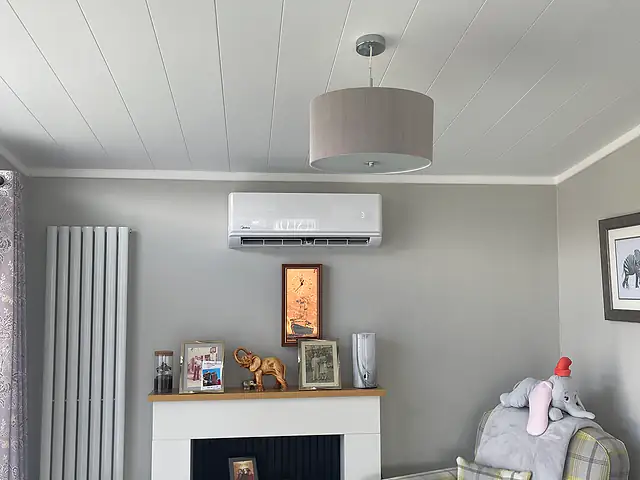
A split air conditioning unit above a living room fireplace, the kind of air conditioning we fit for homes in Highgate
A split air conditioning unit above a living room fireplace. An example of the air conditioning we install for homes in Highgate.

For homes

Highgate homeowners usually want effective cooling that stays visually restrained and very quiet. Typical projects include top-floor bedrooms and studies in period houses, a loft studio, or a single bedroom in a flat where external equipment is tightly controlled. We recommend equipment to suit the room and the building’s rules, from slim wall-mounted splits to floor consoles and ducted units, and explain which borough’s guidance is likely to apply. All of the systems we fit can heat as well as cool, and annual servicing keeps them efficient and near-silent.

Domestic air conditioning
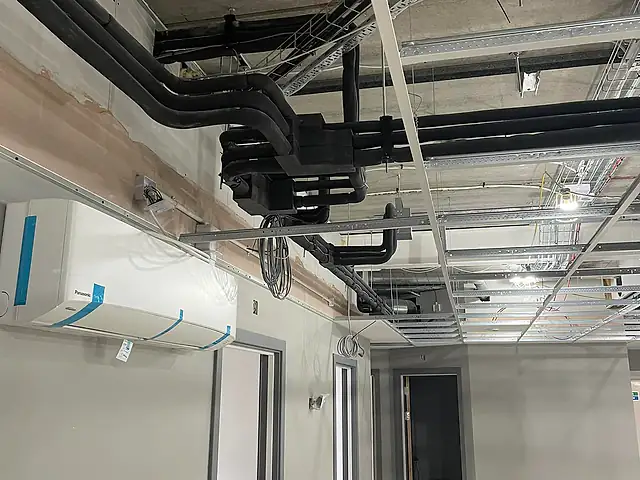

Insulated refrigerant pipework during a commercial fit-out, the kind of commercial air conditioning we fit for businesses in Highgate
Insulated refrigerant pipework during a commercial fit-out. An example of the commercial air conditioning we install for businesses in Highgate.

For businesses

Commercial life in Highgate centres on the village High Street, with independent shops, pubs, restaurants and cafés, plus surgeries, professional offices and the area’s well-known schools. Further down the hill, Archway Road has its own parade of shops and services. Many of these premises occupy old buildings with flats above and little room for plant. We design compact, low-noise systems, find outdoor positions that do not trouble residents upstairs, work around trading hours and provide planned maintenance and repairs so cooling stays reliable through the summer.

Commercial air conditioning

Which Council Handles a Highgate Air Conditioning Question?

The borough boundaries run through the village itself, so two neighbours on the same street can answer to different councils. Before thinking about equipment, it makes sense to confirm your authority, because conservation guidance, application forms and validation requirements vary between them.

Confirming your borough and conservation status

Your council tax bill shows which borough you are in. That council’s website will then tell you whether your address sits within a conservation area and whether the building is listed or locally listed. Highgate has conservation area designations on the Camden, Haringey and Islington sides, each with its own appraisal, so it is the document for your side of the boundary that matters.

  • Check the council tax bill for your borough
  • Look up the conservation area map and appraisal
  • Search the national heritage list for listed status

What a planning officer may want to see

If permission or listed building consent appears necessary, an application usually goes more smoothly when it is precise. We can supply product data, dimensions, sound levels and photographs of the proposed position, and mark the pipe route on plans so the officer can see exactly what changes. Final decisions rest with the council, so we never promise an outcome.

Showing the condenser is not visible from the street

Photographs taken from the pavement and from neighbouring public spaces, with the proposed position marked, help demonstrate that a rear or roof-level unit will not affect the street scene.

Providing noise information up front

Manufacturer sound data, the distance to the nearest neighbouring window and any screening proposed can all be set out in advance. In quiet residential streets this is often the first question raised.

Cooling Flats in Highpoint and Other Twentieth-Century Blocks

Highgate’s modernist and interwar blocks are admired for their clean, unbroken elevations, which is exactly why external condensers are often refused by management companies or difficult to justify on listed buildings. There are still practical ways to cool a flat in these buildings.

Through-wall units with no separate outdoor section

Monoblock air conditioners sit on the inside of an external wall and draw and expel air through two small round grilles, with no condenser outside. Capacity is lower than a split system and they are slightly louder indoors, but they suit a single bedroom or study where an outdoor unit is not allowed. Grilles still change the elevation, so management and, for a listed building, consent will normally be needed.

Where the grilles can go

The two core holes are usually placed low on a rear or side wall, or within an existing window panel if that is acceptable. Finishing grilles to match the wall colour reduces their visual impact considerably.

Using an agreed communal plant position

Some blocks have a roof area, plant room or rear service space where condensers can be grouped. If several residents want cooling, a coordinated approach through the managing agent is often viewed more favourably than individual units scattered across the building, and it keeps refrigerant routes tidy within risers or service ducts.

Why portable units are a poor long-term choice

Portable air conditioners need an exhaust hose through a window, are noisy and struggle in sunny rooms. In a flat with large steel or timber windows they also leave a gap that undoes the cooling. For a permanent solution, a properly designed fixed system is far more effective.

Keeping Bedrooms Cool Beside the Archway Road Traffic

Homes facing the A1 have a different problem from the rest of Highgate: opening a window at night lets in noise and pollution, so summer heat builds up with nowhere to go. Cooling here is as much about sleep and air quality as temperature.

Positioning equipment away from the road side

Front bedrooms can be cooled from a condenser at the rear of the house, with pipework run internally through cupboards or along a landing. This keeps equipment away from the busy frontage, protects it from road grime, and keeps the outdoor fan noise on the quieter garden side where it is less likely to be noticed.

Choosing indoor units for light sleepers

Look for indoor units with a quiet or night mode rated around 20 dB(A) at their lowest fan speed, and fine filters that capture dust. Correct sizing matters: an oversized unit cycles on and off and feels draughty, while a well-matched inverter runs gently all night.

  • Night mode limits fan speed and outdoor noise
  • Washable filters should be cleaned every few weeks in summer
  • Sizing considers road-side glazing and roof exposure
Local properties

Highgate Buildings, From Pond Square to North Hill’s Modernist Blocks

Georgian houses around the village centre

The older houses near Pond Square and the High Street have prominent street elevations, small rear yards and delicate interiors. Outdoor units are best kept low in a rear courtyard or on a back roof, and indoor units should avoid cornices and shutter boxes. Listed building consent may well be needed, so the full pipe route is agreed before work is booked.

Victorian and Edwardian family homes on the slopes

Big houses off Cholmeley Park, Southwood Lane and the roads towards Crouch End often have cellars, lofts and long gardens. That gives room for a multi-split serving three or four bedrooms from one outdoor unit, or a ducted system on the top floor where the loft is deep enough.

Listed modernist and interwar blocks

Highgate has several well-known twentieth-century apartment buildings, some listed at a high grade, with consistent façades that management companies protect closely. External condensers are often not permitted on these elevations, so through-wall units without an outdoor section, or plant in an agreed communal position, may be the only acceptable routes.

Archway Road houses and flats

Victorian terraces and conversions along the A1 face constant traffic. Residents often value cooling mainly so that windows can stay closed on hot nights. Rear-mounted condensers keep equipment away from the road, and quiet indoor units with a night mode make bedrooms usable without opening a sash onto the traffic.

Before you install

Borough Boundaries, Listed Blocks and Hushed Leafy Streets

This is general guidance only. Every building, lease and planning situation is different, so we’ll talk through yours at survey stage.

  1. 01Highgate is split between Camden, Haringey and Islington, and each has its own planning team and conservation area guidance. Confirm which council covers your address before reading any guidance or preparing an application.
  2. 02Many buildings are listed, including some twentieth-century blocks as well as Georgian houses. Listed building consent is likely to be required for external units and may be needed for internal pipe routes through historic fabric.
  3. 03Highgate Hill, Swain’s Lane and the village streets are steep and narrow, with limited parking. Agreeing vehicle access and any parking arrangements in advance keeps installation day running smoothly.
  4. 04Streets near Highgate Wood and Waterlow Park are very quiet at night, so condenser noise is more noticeable than in busier areas. Low-noise models, careful siting and anti-vibration mounts matter here.
  5. 05In blocks with a management company, rules on external equipment can be strict. Ask what is permitted before choosing a system, as it may rule out a conventional outdoor unit altogether.
Pricing explained

Price Drivers for Air Conditioning in N6 Properties

The cost of an installation in Highgate depends far more on the building and its constraints than on brand names. We break each quote into equipment, installation labour, builders’ work and any extra items, so you can compare options such as a conventional split against a through-wall unit.

Type of system the building will accept

Where a conventional split is allowed, it usually offers the best efficiency for the outlay. If management rules or listing push you towards ducted, concealed or through-wall units, both equipment and labour change, and we price the realistic alternatives side by side.

Pipe runs through large period houses

Highgate houses are often tall and deep, with the coolest rooms to serve at the top and the only suitable outdoor position at the bottom of the garden. Longer runs need more materials and time, and very long runs can require additional refrigerant.

Preparing information for consent

Where an application to Camden, Haringey or Islington is likely, drawings, photographs and technical data take time to prepare. Waiting for a decision also affects when the work can be scheduled.

Access on steep and narrow streets

Parking restrictions, steep approaches and houses raised above the pavement add carrying time. Lifting equipment onto a rear roof or through a communal building with lift protection and booking requirements also influences the quote.

Step by step

Our Four Stages for an Installation on Highgate Hill

  1. Borough check and site survey

    We confirm which council covers your address, look at listing and conservation status, then survey rooms, glazing, voids and every realistic outdoor position, including communal plant areas in blocks.

  2. Proposal with permissions mapped out

    You receive a written design showing equipment, pipe routes and sound data, with notes on what your freeholder, management company or planning authority is likely to need to see.

  3. Careful installation on the hill

    Once consents are in place we install with floors and stairs protected, core drill only where agreed, and keep pipework hidden in cupboards, voids or neat covers in keeping with the property.

  4. Commissioning and annual care

    We test, set up night modes and zones, show you how to clean filters, and return each year to service the system so it stays efficient and quiet for neighbours.

FAQs

Highgate Air Conditioning Questions, Answered Plainly

Which council do I contact about air conditioning in Highgate?

It depends on your exact address, because Highgate is split between Camden, Haringey and Islington. Your council tax bill confirms the borough. That authority’s planning team deals with any planning or listed building consent questions, and each publishes its own guidance for its conservation areas, which is worth reading before you finalise a design.

Can I cool a flat in a listed modernist block?

Sometimes, but it needs care. External condensers on listed twentieth-century blocks are often resisted, so options include through-wall units without an outdoor section or plant in an agreed communal position. You will need the management company’s agreement and, because the building is listed, listed building consent is likely to be required for any change to the fabric.

Can a condenser be hidden in a small Highgate garden?

Often it can. It can sit low behind planting or a slatted timber screen, on a rear wall bracket out of sight from the street, or on a flat roof over a back addition. Screens must leave plenty of space for airflow so the unit runs efficiently, and siting should keep it well away from neighbours’ bedroom windows.

Will air conditioning damage period features?

It should not, provided the installation is planned properly. Pipe routes can usually pass through cupboards, floor voids or less significant walls, and indoor units can be positioned to avoid cornices, shutters and panelling. In a listed building any intervention may require consent, so we agree the route in detail before work starts.

I live on Archway Road. Will air conditioning help with traffic noise?

Indirectly, yes. Cooling lets you keep windows closed on hot nights, which shuts out much of the road noise and fumes. Choose an indoor unit with a quiet night mode and fine filters, and site the outdoor unit at the rear of the house where its own fan noise will not add to the problem.

Is one outdoor unit enough for several bedrooms in a large house?

Usually, yes. A multi-split system connects one outdoor unit to two or more indoor units, each with its own control. In tall Highgate houses we check the pipe length and height difference between the condenser and the top-floor rooms, as manufacturers set limits that affect which models are suitable.

Free quote

Request a Survey for Your N6 Home or Business

Tell us about your home or business in Highgate and what you’d like to achieve, whether that’s cooling, heating or both. We’ll come back with advice and next steps.

  • Survey-led advice: recommendations based on your rooms, layout and how you use the space.
  • Clear written quotation: what’s included, the equipment proposed and the next steps.
  • No obligation: ask questions and take your time to decide.
  • CoverageHomes & businesses across Greater London

Request your free quote

A few details help us understand your property and come back with useful advice.

Fields marked * are required. We only use your details to respond to this enquiry.
Get a Free Quote

