
Central London

Mayfair Air Conditioning Specialists

Mayfair's listed townhouses now hold fund managers, galleries, showrooms and some of London's most carefully finished homes. We design, install and maintain air conditioning that stays out of sight, runs quietly and satisfies the estate, the council and the interior designer alike.

  • W1J
  • W1K
  • W1S

Free quote in Mayfair

Homes and businesses: tell us what you need and we’ll be in touch.

Townhouses, Galleries and Fund Offices Between Park Lane and Regent Street

Mayfair is bounded by Oxford Street, Regent Street, Piccadilly and Park Lane, and much of its western half belongs to the Grosvenor estate, with the Crown Estate prominent along the Regent Street side. Its streets are lined with Georgian and later townhouses, many listed and almost all within the Mayfair Conservation Area. Over the twentieth century a large share became offices, and some are now returning to private residential use, so many projects form part of a much wider refurbishment.

The offices around Berkeley Square, Grosvenor Street, Curzon Street and Mount Street are well known for hedge funds, private equity houses and family offices. These are typically small teams in a converted house, with dealing desks, multiple screens per person and a comms room that cannot be allowed to overheat. Cooling has to be resilient as well as quiet, and servicing has to happen without interrupting the trading day.

Elsewhere, galleries on Cork Street and Dover Street, fashion and jewellery houses on Bond Street, tailors on Savile Row, members' clubs and grand hotels all share one expectation: equipment should be almost invisible. Grilles have to line up with joinery, controls must sit neatly on finished walls, and outdoor units must stay hidden behind parapets or in mansard roofs. Achieving that in a listed building requires detailed design and early coordination with every party.

Our services

Private Residences and Mayfair Workplaces We Cool and Maintain

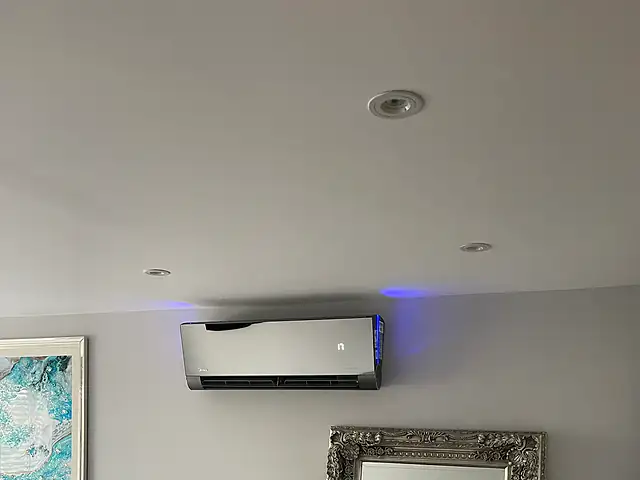
A quiet mirror-finish air conditioning unit above a bed, the kind of air conditioning we fit for homes in Mayfair
A quiet mirror-finish air conditioning unit above a bed. An example of the air conditioning we install for homes in Mayfair.

For homes

Mayfair homes range from lateral apartments in mansion buildings to entire townhouses, and owners generally expect cooling that is silent at night, invisible by day and simple to control from a keypad or phone. We design ducted, multi-split and concealed systems that fit within high-quality interiors, coordinate grille positions with architects and interior designers, and specify heat pump operation so the same system provides efficient heating in cooler months. Bedrooms are set up with quiet night modes and gentle air distribution.

Domestic air conditioning
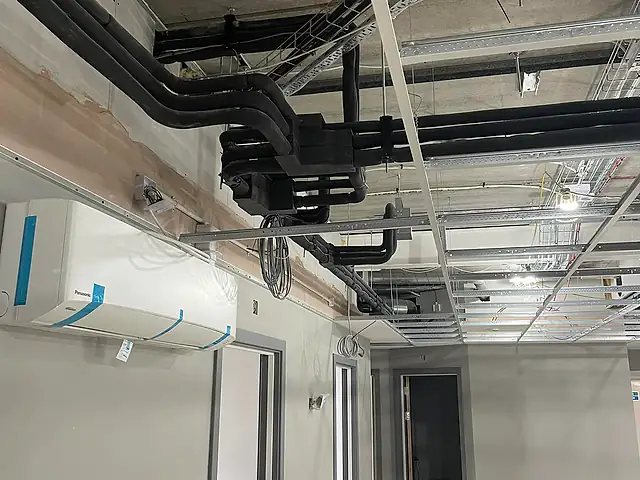

Insulated refrigerant pipework during a commercial fit-out, the kind of commercial air conditioning we fit for businesses in Mayfair
Insulated refrigerant pipework during a commercial fit-out. An example of the commercial air conditioning we install for businesses in Mayfair.

For businesses

In Mayfair we serve hedge funds, private equity and family offices, galleries, showrooms, tailors, hotels, members' clubs and restaurants. Most work takes place in listed or historic buildings owned by demanding estates, so we produce detailed proposals and work strictly within site rules. Planned maintenance keeps systems efficient and quiet, and dedicated, resilient cooling for comms rooms supports firms that cannot tolerate IT downtime. Visits are scheduled around trading hours, private views and guest occupancy.

Commercial air conditioning

Concealed Ducted Systems in Grade-Listed Mayfair Townhouses

Ducted air conditioning is the usual choice in Mayfair's finest interiors because the only visible elements are slim grilles and a wall controller. The challenge in a listed townhouse is finding space for the units and ductwork without disturbing historic ceilings and joinery.

Using secondary rooms and lowered ceilings

Principal rooms on the first floor often have decorative ceilings that cannot be touched. The usual approach is to place ducted units in the ceilings of adjoining corridors, bathrooms or dressing rooms, then supply the principal room through grilles in a wall, cornice line or joinery. Return air paths need just as much thought as supply, or the system will be noisy and underperform.

Linear grilles and joinery integration

Slot diffusers can be built into bookcases, window reveals or panelling so that air appears to come from the furniture itself. Finishes can be painted to match. Grille sizes are calculated to keep air velocity, and therefore noise, low.

Access panels for future servicing

Concealed units still need filter cleaning and occasional repairs. We position discreet access hatches in cupboards or secondary ceilings so maintenance does not mean cutting into finished decoration later.

Hidden roof plant behind parapets and mansards

Mayfair townhouses commonly have a mansard roof or a flat section behind a parapet. Outdoor units can often sit there out of public view, sometimes inside a louvred enclosure designed to match the roof. Structural loads, rainwater drainage, the distance to neighbouring windows and safe access for servicing all need checking, and the enclosure itself may form part of the planning and estate submission.

Resilient Cooling for Fund Offices and Their Comms Rooms

A small investment firm in a converted house relies on two very different systems: comfortable conditions for people working long hours at screen-heavy desks, and uninterrupted cooling for the network and servers that support trading.

Comfort cooling for dealing desks and meeting rooms

Desks with several monitors per person produce concentrated heat, and boardrooms swing from empty to full. A VRF system with an indoor unit and controller in each room handles those variations efficiently, and can provide heating to perimeter rooms while cooling the interior. Indoor units are selected for low sound levels so calls and meetings are not disturbed.

Redundant cooling for the comms room

The comms room should have its own cooling, independent of the office system and designed to run every day of the year. Two units sized so that either can carry the load alone, with automatic changeover and an alarm, means one failure does not become an outage.

  • Size from the equipment's actual heat output
  • Choose units rated for year-round and low-ambient operation
  • Fit temperature alarms that alert the operations team
  • Service both units on a planned schedule

How Should a Mayfair Gallery Control Temperature and Humidity?

Stability matters more than coldness. Works of art and fine objects suffer most from rapid changes in temperature and relative humidity, which can occur when a crowded private view is followed by a cool, empty night.

Steady conditions instead of aggressive cooling

An inverter system that modulates gently, rather than switching on and off, avoids sharp swings. Set points are agreed with the gallery and kept consistent, and controls can be locked so they are not adjusted during an event. Where lenders or insurers specify environmental ranges, the system can be designed and monitored to suit.

Keeping air movement off hanging walls

Direct airflow across a painting can dry or chill its surface unevenly. Diffusers are placed to distribute air across the ceiling and away from hanging walls, and ducted systems with low discharge velocity are usually preferred to cassettes in exhibition rooms. Separate humidification or dehumidification can be added where air conditioning alone cannot hold humidity within the agreed range.

Local properties

Mayfair Interiors Where the Equipment Has to Disappear

Townhouse offices

Converted houses with an office on each floor typically take concealed ducted units or a VRF system with individual room control. Condensers go on the roof behind the parapet or within a mansard plant enclosure, with pipework in existing risers.

Lateral apartments and whole houses

High-specification homes usually integrate ducted cooling into ceilings and joinery, with slot or linear grilles and smart controls. Any scheme must fit the building's rules on plant, noise and permitted working hours, which in managed blocks can be strict.

Galleries and showrooms

Paintings, works on paper, furniture and luxury goods are sensitive to rapid temperature and humidity swings. Stable, gently delivered cooling, sometimes paired with humidity control, protects stock while keeping visitors comfortable during busy openings.

Hotels, clubs and restaurants

Hospitality buildings need quiet, high-capacity systems serving many rooms with very different loads. Heat recovery VRF can move heat between rooms that need cooling and those that need warming, improving efficiency in a deep, mixed-use building.

Before you install

Estate Licences, Conservation and Logistics in W1J and W1K

This is general guidance only. Every building, lease and planning situation is different, so we’ll talk through yours at survey stage.

  1. 01Almost all of Mayfair lies within a conservation area and many buildings are listed, so external plant is likely to need planning permission from Westminster City Council and, where relevant, listed building consent for both internal and external works.
  2. 02The Grosvenor estate and the Crown Estate own large parts of the district and typically operate their own licence process, with design expectations about plant enclosures, pipe routes and noise that run alongside any council consent.
  3. 03Westminster pays close attention to plant noise near homes and hotel bedrooms, so an acoustic assessment may be needed and condensers should be selected with sound data and night-time operation in mind.
  4. 04Parking is very limited and Park Lane is a red route. Deliveries, crane lifts or road-space licences for scaffolding usually need advance arrangement with the council and the building's management.
  5. 05Galleries and showrooms often run exhibition or seasonal schedules, so works and planned maintenance are best fixed well in advance to avoid openings and busy trading periods.
Pricing explained

Why Mayfair Air Conditioning Projects Vary in Price

No two Mayfair quotes look alike, because the cost is driven far more by the building, the finish and the approvals than by the equipment alone. Every quotation follows a survey and itemises equipment, installation, controls, builder's work, access and documentation so each cost is visible.

Level of concealment and interior finish

Fully concealed ducted systems with custom grilles built into joinery involve more design, coordination with other trades and installation time than wall-mounted units. The quality of the surrounding finish also affects how carefully work must be protected and made good.

Listed building and estate approvals

Preparing drawings, specifications, acoustic data and method statements for listed building consent, planning and the estate's licence takes time. Plant enclosures designed to satisfy those parties can add materials and fabrication.

Resilience for comms and equipment rooms

Duplicated cooling, automatic changeover and remote alarms for a fund's comms room cost more than a single unit, but they reduce the risk of an outage. We price resilient and standard options side by side where both are realistic.

Access, lifting and road licences

If equipment cannot be carried through the building, a crane or hoist with a licence for road space may be needed. Limited parking and timed delivery slots also affect the programme and are reflected in the quote.

Timing around trading, events and guests

Work scheduled for evenings, weekends or between gallery exhibitions often costs more in labour than a standard weekday programme. Agreeing the timetable up front keeps the quotation accurate.

Step by step

Planning a Mayfair Installation Step by Step

  1. Survey with your architect or designer

    We survey the building, measure heat gains room by room, and review voids, risers and roof space alongside your architect or interior designer so equipment positions are agreed before any finishes are designed.

  2. Design package for estate and council

    We prepare layouts, grille schedules, plant enclosure details and sound data to support the estate's licence application and any planning or listed building consent submission to Westminster City Council.

  3. Coordinated installation

    First-fix pipework, ductwork and cabling are installed in step with other trades, with finishes protected throughout. Plant is lifted or carried in to agreed timings, and noisy work follows the building's permitted hours.

  4. Commissioning, controls and maintenance

    We commission every zone, set up smart or central controls, verify sound levels in bedrooms and meeting rooms, and agree a maintenance schedule that fits around the household, office or gallery calendar.

FAQs

Mayfair Clients' Common Questions About Cooling

Can air conditioning be installed in a listed Mayfair townhouse?

Usually, with the right consents. Listed building consent is likely to be needed for internal and external works, and the estate landlord may also need to approve the scheme through its licence process. Concealed systems that use existing voids, secondary rooms and hidden roof positions tend to be the most acceptable, and good documentation from the outset helps the applications move smoothly.

How can I protect artworks in a Mayfair gallery?

Stable temperature and humidity are the priority. An inverter system that modulates gently, with diffusers that keep air off hanging walls, avoids the sharp swings that harm paintings and works on paper. Where air conditioning alone cannot hold humidity in range, separate humidity control can be added. Regular servicing keeps performance consistent, which is especially important around exhibitions and private views.

What cooling suits a small fund office in a Mayfair house?

A VRF or multi-split system with an indoor unit and controller in each office and meeting room is common, with concealed units where the interior demands it. The comms room should have separate, ideally duplicated, cooling that runs all year with an alarm. Condensers are typically located on the roof behind the parapet to keep them out of public view.

Will the estate let me put a condenser on my roof?

Often a hidden roof position is acceptable, but the decision rests with the estate and, for visible or listed buildings, with Westminster City Council. Estates typically want plant out of sight, enclosed where necessary and quiet enough not to disturb neighbours. We provide drawings, sound data and enclosure details so the request can be assessed properly.

Can installation work around our interior designer's programme?

Yes, and it should. The best results come from fixing air conditioning positions before joinery and ceiling designs are finalised. We work from the designer's drawings, agree grille and access panel locations, and install first-fix pipework and ductwork in sequence with other trades so finished surfaces are not disturbed later.

How quiet can a Mayfair bedroom system be?

Well-designed ducted systems with low air velocity and units placed outside the bedroom can be barely audible on night settings. Wall-mounted units also have very quiet low-fan modes. The key factors are grille sizing, keeping the unit and any condensate pump outside the room, and isolating the outdoor unit from the structure with anti-vibration mounts.

Free quote

Discuss a Discreet System for Your Mayfair Building

Tell us about your home or business in Mayfair and what you’d like to achieve, whether that’s cooling, heating or both. We’ll come back with advice and next steps.

  • Survey-led advice: recommendations based on your rooms, layout and how you use the space.
  • Clear written quotation: what’s included, the equipment proposed and the next steps.
  • No obligation: ask questions and take your time to decide.
  • CoverageHomes & businesses across Greater London

Request your free quote

A few details help us understand your property and come back with useful advice.

Fields marked * are required. We only use your details to respond to this enquiry.
Get a Free Quote

